VANGUARD - Expressing the viewpoint of the Communist Party of Australia (Marxist-Leninist)
For National Independence and Socialism • www.cpaml.org
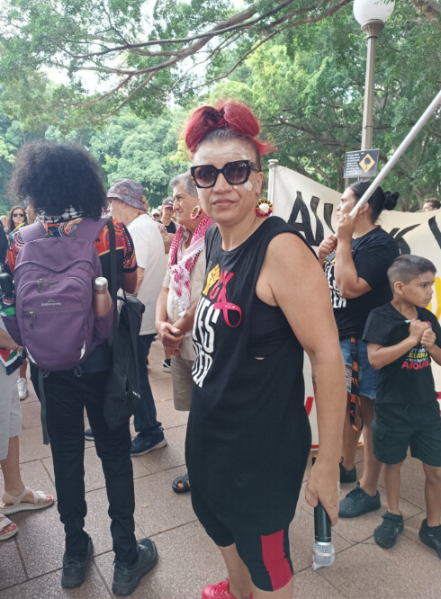
Auntie Lizzie Jarrett waits for the march to begin
La Perouse near the northern headland of Gamay Botany Bay, is Bidjigal and Gadigal land. The British invaders’ First Fleet set anchor nearby, before moving to the deeper waters of Warrane Sydney Cove.
Pemulwuy who led the first systematic armed resistance was Bidjigal. For 30 years it flamed from the wetlands and flanking rocky ridges, then west and north along the Hawkesbury River with Darug and Gundungurra alliances, to temporarily drive the British from Parramatta.
What became the ‘La Pa’ community drew Yuin (who had always traded and done ceremony) north. La Pa helped hold this resistance story that now inspires us.
The La Pa mob always resisted invasion, winning the fight to stay on their land. Even as a mission, its Peoples took part in the 1938 Day of Mourning on January 26. La Perouse was a spearhead in the huge 1988 Survival Day gathering from across the continent.
1988’s spirit continued in the yearly Survival Concert until it moved as Yabun (‘music to a beat’, a reference to the importance of culture in survival) to Victoria Park at the western end of Sydney CBD bordering Redfern, that other, but later, great centre of resistance.
In their juggernaut to divide first peoples, the Business Council of Australia targeted both La Perouse and Redfern, just as they targeted communities whose lands held other rich resources, Called Jawun, the BCA launched it in 2000, the year of that other huge – but connected – march across Sydney Harbour Bridge.
A bloodline of warriors
At Sydney’s Invasion Day a young La Pa speaker first honoured ‘our ancestors for their bravery’.
He said, ‘All the rights we have now were fought for by our Elders. We have to keep that same fire burning.’
On the horrific human incarceration statistics, he said, ‘It’s up to us to stop that!’
Aunty Lynda June Coe said, ‘We keep turning up every year … a bloodline of warriors’, her Wiradjuri People, ‘standing in solidarity with the Peoples along the coastline.’
‘Our young people are powerful,’ she said, ‘despite the chokehold around our necks.’
She honoured her warrior uncle Paul Coe who died in 2025. He took a leading role in every major struggle from the early 1970s, including the founding of the Aboriginal Medical Service and the Aboriginal Legal Service.
Against an undeclared war she said, ‘We are driven by love and respect.’
Aunty Lynda June continued, ‘We have strategies to mobilise. A coalition is growing. We plant the seeds today. We water them. A hundred years on, our young people will benefit from it.’
A figure in chains
Bundjalung Gumbaynggirr Dunghutti woman Aunty Lizzie Jarrett introduced her Dunghutti nephew, Paul Silver. Years of collective resistance has made him a formidable leader. As a grief-stricken young teen he cried out and ran from the Sydney Coroners Court as video of the murder by suffocation of his uncle, David Dungay Jnr, played on screen.
Aunty Lizzie praised his leadership against police threats to stop the protest. Permission or not, backed by the knowledge people would defy the police order, he fronted police to force a backdown.
Paul Silva spoke poetry of power. ‘We were here before the ships’ and the invader’s ‘chains described as law’.
And now, ‘stealing our heart while making profit.
‘Yet still we stand on sacred land, stronger than their lies. Stronger than their prisons.
‘We are still rising. They try to erase us.
‘But still we rise, in a country that always was, always will be, Aboriginal land.’
At La Pa a figure of a convict in chains is carved into the rocks. First Peoples cried as flesh was gouged from convicts whipped in Sydney Town. They sometimes sheltered runaways.
The coalition Lynda June Coe spoke of was born then. It has only grown stronger.