VANGUARD - Expressing the viewpoint of the Communist Party of Australia (Marxist-Leninist)
For National Independence and Socialism • www.cpaml.org
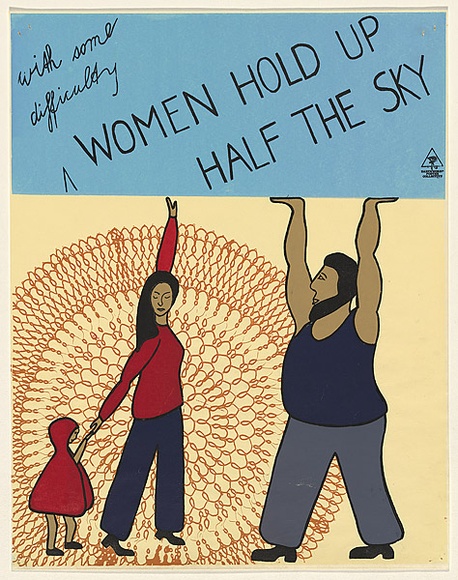
(Artist: Pam Ledden; source: www.printsandprintmaking.gov.au)
As domestic violence rates rise across Western Australia, the limits of awareness campaigns and incremental reform are becoming increasingly clear. A socialist perspective argues that women’s oppression is rooted not only in culture, but in material conditions — housing insecurity, economic dependence, racial inequality and the privatisation of care. By restructuring the economy around collective provision, secure housing, workplace power and community accountability, socialism offers a framework aimed at addressing the structural drivers of gendered violence in Australia.
This International Women’s Day, it feels impossible to look toward the community of Western Australian women to which I belong and not acknowledge the current trends of violence. In 2024–25, WA Police revealed that more than 42,000 offences involving assault or threatening behaviour occurred in domestic and family situations — an 18 per cent increase from the previous year. According to the WA government, 30 per cent of adult women in the state report having experienced some form of abuse from a partner. First Peoples women are 32 times more likely to be hospitalised from violence than non-First women.
From survivors, services and children affected, the message is consistent: the problem is real, terrifying and growing.
Yet political responses remain measured to the point of inertia. Premier Roger Cook has suggested rising reports may reflect increased awareness. Women and children affected do not want awareness; they want meaningful intervention. Services across the state are stretched beyond capacity. The Centre for Women’s Safety and Wellbeing has repeatedly called for significant frontline funding increases. The government’s response has been to describe the issue as “complex” and “not as simple as writing a cheque.”
It is true that domestic violence is complex. But complexity cannot become an excuse for inaction.
The Australian Bureau of Statistics reports that one in three men aged 18–65 have used intimate partner violence. Cultural ideas of Australian identity remain intertwined with hardened notions of masculinity — emotionally repressed, economically productive, stoic and dominant. As economic pressures intensify — housing costs soaring, wages stagnating, homelessness rising — insecurity grows. When employment becomes precarious and living costs consume more of household income, stress is not distributed evenly. Women, particularly working-class and Indigenous women, often absorb the consequences.
A socialist analysis begins from a simple premise: violence does not occur in a vacuum. It is shaped by material conditions. Economic dependence, housing insecurity and social isolation create environments where abuse can flourish. When leaving an abusive relationship means facing homelessness, poverty or losing access to childcare, “choice” becomes a hollow word.
In Australia’s market-driven housing system, refuge spaces are limited and long-term social housing waitlists stretch for years. Childcare remains costly. Casualised labour disproportionately affects women. First Peoples’ communities continue to live with the compounded trauma of dispossession and disempowerment, over-policing and underfunding. Addressing domestic violence, from this perspective, requires more than awareness campaigns or reactive policing. It requires structural change.
Socialist policy approaches focus on economic independence and collective provision. Secure, publicly funded housing reduces the barriers to leaving violent situations. Universal childcare enables women’s workforce participation. Stronger labour protections and union representation increase bargaining power and financial security. Expanded, fully funded frontline services ensure that when violence occurs, survivors are not met with waiting lists.
Crucially, a socialist framework also recognises care work — often unpaid and performed by women — as socially necessary labour. By socialising aspects of care through public services, the burden is not left to individual households where isolation can conceal abuse.
None of this suggests that culture is irrelevant. Gender norms and harmful conceptions of masculinity must be challenged. But cultural transformation is difficult without economic transformation. A society organised around competition, private accumulation and individual survival struggles to cultivate collective accountability.
The disproportionate violence faced by First Peoples women underscores this reality. Solutions must include investment in Indigenous-led services, community-controlled housing and justice alternatives that address the legacy of settler colonialism. Structural inequality cannot be separated from gendered violence.
International Women’s Day often celebrates resilience. Yet resilience is not the same as justice. Western Australian women continue to hold up half the sky — in workplaces, in homes, in communities. The question is whether the structures beneath that sky will continue to rest on insecurity and privatised burden, or whether they will be rebuilt around collective wellbeing.
If domestic violence is rising while awareness grows, then awareness alone is not enough. The scale of the crisis demands more than symbolic recognition. It demands material change.