VANGUARD - Expressing the viewpoint of the Communist Party of Australia (Marxist-Leninist)
For National Independence and Socialism • www.cpaml.org
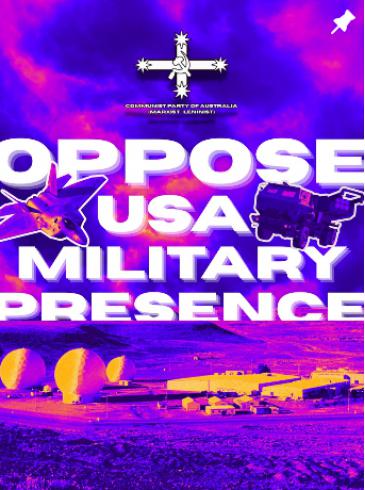
Hidden within recently announced US defence spending lies information about highly sensitive signals-intelligence (SIGINT) facilities focussed on the Pacific, using the military facilities of allies, including Australia and Japan. The information remains well hidden. The US remains preoccupied with the changing balance of forces already taking place across the Pacific. The vast region is regarded by the Pentagon as a potential theatre of war with China; the US, therefore, monitors Beijing's 'soft diplomacy' in the Pacific and their ability to consolidate an already formidable power-base.
In late April the US congress announced their approval for defence spending of over US$1 trillion; it is also set to increase to US$1.5 trillion next year. (1) Hidden in the small print of the government documents lies where some of the defence spending has been allocated. The Philippines, for example, now hosts nine US military facilities inside their own military bases. Some of the US facilities are regarded as off-bounds to Philippine citizens, revealing their sensitive nature and higher levels of security clearances used by the Pentagon. Other countries, likewise, have similar facilities.
The sensitive US military facilities include higher level access to their Pacific Deterrence Initiative designed to establish a network of precision-strike missiles along the first island chain, with similar facilities lodged along the second island chain; the radar systems are used for intelligence-gathering. (2) The whole system is expected to be fully operational next year. (3)
The main focus of US involvement in the Pacific has been China, which is regarded as a serious competitor to traditional US hegemonic positions. In fact, a US congressional commission nearly a decade ago concluded 'that the US is no longer clearly superior to the threats … it faces … and that it would struggle to win wars against China'. (4)
The balance of forces has already swung, and swings still further.
The commission, moreover, recommended the US 'further relying on traditional allies, including Australia and Japan'. (5) It was, therefore, no surprise to find examples of recent high-level diplomacy between the two countries. Last month, coinciding with the US announcement of their defence spending, Australia, for example, hosted the new Japanese prime minister, Sanae Takaichi in Canberra, for high-level diplomatic talks which included reference to 'growing security and defence co-operation'. (6) The US has had to increasingly rely upon Australia and Japan as two major regional hubs for 'US interests' after the Trump administration sidelined India as a strategic corner of the so-called 'Quad'.
The role of the US, furthermore, has not been ambiguous; their intelligence assessments that Australia 'is grossly unprepared for modern warfare', leaves little to the imagination. (7) The Pentagon is not planning for the maintenance of the status quo, but aggressive foreign policy initiatives to effectively challenge China, diplomatically and militarily.
The finalisation of a new defence and security agreement between Australia and Fiji, the Vuvale Union, has drawn a highly geo-strategic country in the Pacific, into Australia's military orbit. (8) The fact that Fiji swings on an arc from the Lavarack Barracks near Townsville, including the Solomon Islands, Vanuatu and Canberra, is not coincidental. The Queensland-based military facilities host Combat Signals and the Combat Services Support Battalion. (9) They also provide Australian-based military facilities with their US counterparts, operational since the Vietnam War over half a century ago. (10)
Pentagon military intelligence assessments fear Vanuatu negotiating a pact with China, leading to the establishment of military facilities in what has, historically, been inside Australia's defence and security cordon for protection from incursions from northern sources. (11)
The Solomon Islands, likewise, remains diplomatically close to China. The tiny country of only 850,000 inhabitants, is only 2,000 kms from Australia, and regarded a geo-strategic for Australia's defence and security. The recent ousting of prime minister Jeremiah Manele in a no-confidence vote, has already heightened diplomatic tensions with Canberra. It has been noted that, 'leadership changes in the strategically located archipelago are closely watched by western diplomats'. (12) How they watch developments, remains the matter in question.
And developments, elsewhere, have some bearing upon the matter.
Political discourse in the US congress and senate have finally approved a bill extending controversial surveillance programs which focus upon section 702 of the Foreign Intelligence Surveillance Act, which is responsible for the US intelligence services collecting and analysing vast troves of foreign telecommunications without a warrant. (13)
The surveillance system used by the US intelligence services rests upon the Echelon facilities composed of vast computer banks programmed to collect all telecommunications, which have now been upgraded with AI for profiling. (14) The facilities are referred to as data-centres, in polite diplomatic discourse.
Amid the US-led diplomatic challenge to China, the Trump administration have announced their choice of a new diplomatic representative in Canberra. Aptly named, Dr. Brat, is set to soon arrive in Canberra. Conservative, and a noted right-winger, Brat resides in that shadowy area of Christian fundamentalism and has been noted as having attacked 'moral relativism'. (15) His appointment, as envoy denotes his role in the wider region, not merely Australia. No doubt he will be kept very busy monitoring developments in the Pacific:
We need an independent foreign policy!
1. Military spending surges to $4 trillion, Australian, 28 April 2026.
2. US to build anti-China missile network along first island chain, Nikkei, 5 March 2021; and, US Indo-Pacific Command proposes new missile capabilities to deter China, RFA., 5 March 2021.
3. Ibid.
4. Study: US no longer dominant power in the Pacific, Information Clearing House, 22 August 2019.
5. Ibid.
6. Official Media Release: Prime Minister of Australia, Visit to Australia by the Prime Minister of Japan, 28 April 2026; and, Deepening security ties with Japan matter at 'severe time', Editorial, Australian, 5 May 2026.
7. Australia 'not ready' for modern conflict, Australian, 25 February 2026.
8. 'Knife fight' heats up in Pacific, Australian, 6 May 2026.
9. Wikipedia: Australian Military Bases.
10. Ibid.
11. Australian, op.cit., 6 May 2026.
12. PM's ousting ripples across Pacific, Australian, 8 May 2026.
13. Spy bill extended, Australian, 20 April 2026.
14. See: Echelon, Espionage, Spies and Secrets, Richard M. Bennett, (London, 2002), PP. 89-93.
15. Donald Trump names former Republican congressman as new US ambassador to Australia, ABC news, 28 April 2026; and, Tea Party hero to be envoy down under, Australian, 29 April 2026