VANGUARD - Expressing the viewpoint of the Communist Party of Australia (Marxist-Leninist)
For National Independence and Socialism • www.cpaml.org
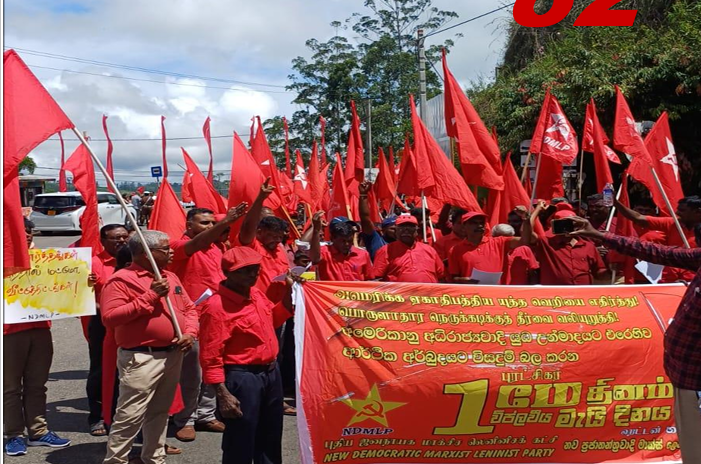
(Above: source MLND)
The following report is by comrades of the New Democratic Marxist-Leninist Part of Sri Lanka. In 2022, widespread demonstrations led to the overthrow of the SLPP government, and the allegedly “leftist” JVP-NPP was overwhelmingly elected in 2024. It did not, however, dismantle the old state machinery through which the Indian regional expansionists and the US imperialists sought to expand their influence and power. This report provides some details of interest to all in our region – eds.
There is now no doubt or secret about the JVP‒NPP sell out to the US and India. As the US acts to consolidate its military footprint, India focuses on its economic hold and buying influence among the country’s elite.
On 23rd June the Sri Lanka Air Force received ten discarded Texas-built TH-57 Sea Ranger helicopters under the U.S. Excess Defense Articles program. Two days later, the US formally designated the Sri Lanka Navy as a key partner in its Indo-Pacific strategy. Sri Lanka’s current defence partnership with the US began in November 2025 when its armed forces paired with the Montana National Guard under the State Partnership Program covering assistance with high-tech communications, transfer of decommissioned US naval vessels, capacity building at naval bases, high level military visits, strategic consultations, defence agreements and joint naval exercises like the series of joint activities conducted by the U.S. Coast Guard and the Sri Lanka Coast Guard.
The US, owning Sri Lanka’s largest export market, uses the advantage to bully Sri Lanka. When the US recently imposed tariffs on exports, Sri Lanka pleaded for mercy only to submit to the demands of the US. The US seeks to promote a role for its private investors in Sri Lanka’s ports, aviation and digital sectors. Notably, energy is a sector in which the US has demanded a larger share since early this decade, something that the JVP‒NPP had vehemently opposed until assuming power.
India is seeking economic and trade integration to enhance its economic grip. Indian FDI in Sri Lanka, involving heavy investments in energy, fuel retail, luxury hotels and automotive manufacturing, has reached $2.8 billion. Plans are afoot to conduct cross-border trade in the local currencies and expand trade in services, digital commerce and investment beyond the scope of the current Free Trade Agreement (FTA) through a comprehensive Economic Partnership Agreement (EPA).
India, is also strengthening its position in infrastructural development and connectivity through projects such as the energy hub in Trincomalee, jointly with the UAE and Sri Lanka, the Three Islands Hybrid Renewable Energy Project besides interconnection of power grids of both countries, and drawing Sri Lanka into the Indian digital payment system to facilitate real-time cross-border transactions. Bilateral efforts are afoot to strengthen logistical connections including ferry services and air transport from the Jaffna peninsula. Talks have also been reactivated on a marine bridge.
India has intensified development assistance besides credit assistance. Its support for community development projects in the North and East has now extended to the Hill Country where it is actively seeking influence among the Hill Country Tamil nationality. Its four High Commission offices in the island visibly exploit cultural commonalties to strengthen influence among the Tamil-Hindu elite.
India has often used the ‘China threat’ to promote its expansionist schemes in South Asia, and seeks to bring Sri Lanka under a common South Asian security umbrella. Pretexts of maritime security, counterterrorism, and regional stability serve to strengthen strategic collaboration.
Matters have passed the point of persuading the JVP‒NPP government to reverse its treacherous path of surrendering the sovereignty of the country to the main imperialist power and the regional hegemon. The government is unlikely to fulfil any of its pledges but for selectively punishing past perpetrators of economic and social crimes, using the draconian PTA which it pledged to scrap. The government is also bound to rely heavily on the state machinery and the chauvinist clergy for its survival.
It is for the progressive left and democratic forces to awaken the public to the harsh reality of the JVP‒NPP government and mobilise the masses for genuine revolutionary action for national salvation and social justice.