VANGUARD - Expressing the viewpoint of the Communist Party of Australia (Marxist-Leninist)
For National Independence and Socialism • www.cpaml.org
Political disagreements about the role of Robert Menzies, who became an important leader of the Australian Liberal Party, reveal far more than what can be observed at face value.
The recent disagreements also throw light upon factors which led to the creation of the party around Menzies and its present-day fate and subsequent fragmentation; emerging from diverse political entities, it is now rife with warring and destructive factions.
The Australian Liberal Party response to the allegation made in Canberra by Defence Industry Minister Pat Conroy has added little to the ongoing controversy about the branding of Sir Robert Menzies as a 'Nazi appeaser'. The nature of their response has, however, added insight into how the Liberals continue to regard the whole matter as extremely sensitive; and for good reason, on their part.
Historical commentary surrounding the origins and development of the Liberal Party has tended to be written by those who want a clean-cut image of its founding leader Menzies, rather than serious political and historical analysis. The new Liberal Party organisation in 1944 had drawn together eighteen different political organisations which regarded themselves as 'anti-Labor'. (1) The new right-wing political party soon grew rapidly into a national organisation and part of the Australian political landscape. (2)
Menzies was a supporter of the appeasement trend in Europe. Following the September 1938 Munich Agreement, he wrote to British PM Neville Chamberlain that Germany's proposals on Poland appeared "much more reasonableness than might have been expected", and that a flat Polish rejection could damage public opinion.
Menzies, for example, made a number of highly questionable political judgements, which have been well recorded. In July 1939, only weeks before the outbreak of war, speaking in Melbourne, he said: "History will label Hitler as one of the really great men of the century."
In a letter dated 11 September 1939, he wrote to the High Commissioner in London declaring 'it is really quite indefensible for us to be dictating to the German people what sort of government they shall have'. "I feel quite confident that Hitler has no desire for a first class war..." (3)
The Liberal response, issued through the Menzies Institute, about the correspondence dismissed it as 'thinking out aloud to a friend'. (4) The wholly unsatisfactory manner of the response is noteworthy, in itself. As is most of their other 'historical' analysis.
Senior decision-makers do not think out aloud, but respond to sensitive assessments and intelligence reports provided by senior government officials; they also do not then classify the material as Secret without having good reason to keep personal judgements away from public scrutiny.
The controversial letter, furthermore, has to be assessed in the following context: in August 1938 Menzies visited Nazi Germany in an official high-level diplomatic capacity with the 'principal object of his visit was to observe the political situation'. (5) In that capacity Menzies visited the Siemensstadt corporate entity to inspect facilities provided by the company for their workers. (6) During the same period Menzies was also responsible for writing to his sister 'showing a degree of admiration for Hitler and downplaying the prospect of war'. He said "The abandonment by the Germans of individual liberty ... has something rather magnificent about it." (7)
During the period it was not uncommon for political thinkers to draw attention to the rapid economic development of Germany following economic collapse after the First World War. The role of the State, in Germany, to guide economic development was well recorded. And also criticised by those who looked deeper into the nature of fascism and Nazism.
The creation of concentration camps for 'political undesirables', under State control, likewise, was, for example, also well recorded: Communists, Romany gypsies, Jews, physically and mentally handicapped peoples, gays, together with numerous others. They also provided a major contribution toward the wider economic development of the Germany of the period. In fact, the camps were planned to eliminate all those who obstructed the massive flows of capital into State-run corporate entities devoid of industrial relations procedures to challenge exploitation. The politics of Nazism followed the basic economics of exploitation and creation of a German corporate system designed to enslave the working-class and maximise profits.
Menzies, in his official capacity, must have known about the wholesale exploitation, abuse and genocide taking place in the concentration camps; that is, if his advisors were competent enough to read newspapers and discussed matters arising amongst themselves. International aid agencies were assisting those who had first-hand knowledge of the concentration camps and their re-settlement in countries such as Britain from the mid-1930s. Did they read the reports of survivors? Were they even interested? It would appear not to be the case.
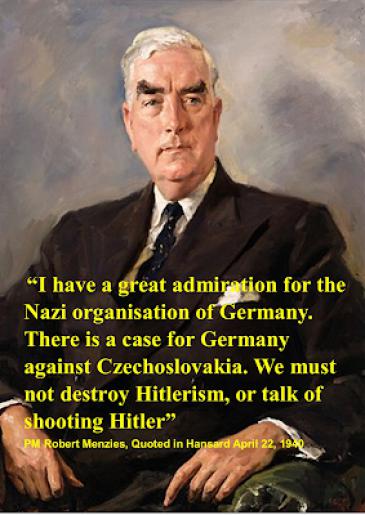
On April 22.1940 Tasmanian Labor MP Gerald Mahoney quoted Menzies, now Prime Minister, as “responsible for encouraging the Nazi organizations that exist in Australia to-day, using mean and contemptible methods to destroy the nation. When I walked along one of Canberra's streets with him some time ago he said, ‘I have a great admiration for the Nazi organization of Germany. There is a case for Germany against Czechoslovakia. We must not destroy Hitlerism or talk about shooting Hitler, the gunman of Europe.’ In this address to the people of Australia, the Prime Minister put up a case on behalf of Nazi-ism. He attacked the party of which I am a member because it opposed Nazi-ism from its inception.” Menzies never retracted the accusation.
The closer look at the context of the Australian corridors of power of the day and its subservient nature to that of Whitehall and Westminster remains an important consideration for the wider understanding of the environment in which Menzies moved. From the mid-to late 1930s the threat of war loomed large in Britain; the peace movement reformed and gained considerable support amongst those who had no wish for a return to the horrors of the First World War. The fascist movement, likewise, gained momentum throughout the same period. It was particularly conspicuous in Australia.
The role of Oswald Mosley's Blackshirt movement has been well recorded elsewhere; some of the smaller splinter fascist organisations, however, were allowed to quietly submerge and escape the scrutiny of many observers. They played their cards close to their chests, for good reason; they had no wish to either be identified or be held responsible for divulging their associates. They were a fascist Fifth Column inside the British State.
During the 1920s MI5 had taken 'a passing interest in the small fascist splinter groups … but rightly regarded them as of little significance … during the early 1930s MI5 and the Special Branch began for the first time to pay serious attention to right-wing as well as left-wing subversion'. (8)
Established in the late 1930s, the so-called British Right Club was composed of well-placed ruling class figures who attended secret meetings and organised in a clandestine manner; it co-ordinated contacts with a range of other fascist organisations including the Nordic League, National Socialist League, the Imperial Fascist League, the Link, The White Knights of Britain, and others. (9) Military links were established as a matter of course. As, no doubt, intelligence connections, through social contacts established inside elite private schools. Noted disagreements also took place over freemasonry; an indication of deeper loyalties and divided loyalties amongst the initiated. (10)
The Right Club, moreover, had 235 members, of which a hundred were female, and included several well-placed Conservative Party members together with House of Lords counterparts. (11) Its membership list also remained secret until the late 1980s. (12) While numerous allegations about its existence took place throughout the decades, the Right Club resided inside plausible denial; that is, until MI5 files were finally declassified, decades later. Its membership had been placed under surveillance, proving their existence. (13)
It would appear inconceivable that Menzies, with his regular contacts with Whitehall and Westminster, did not have some contact with the shadowy fascist grouping and their associates; discourse would have taken place both at an official diplomatic level and in ordinary social discourse through well-placed intermediaries acting as advisors and staffers. They operated subject to parliamentary security and their agendas, however, were not open to public scrutiny at the time.
One political group which eventually merged with the Menzies Liberal Party in 1944 may well have been a suitable conduit for some questionable agendas. It expressed loyalty to the Throne and opposition to socialism and had conservative social policies.
It was also openly supported by the Victorian Employers Federation. (14) The AWNL quickly submerged into the sprawling Liberal Party. It left little trace of its previous existence.
In conclusion, studies of contemporary far-right political movements might find listed criteria for identifying members and associates also useful for a historical study of the Menzies period and its associates who moved freely within the newly established Australian Liberal Party circles. They include: primarily white identities, ethno-centricity, strict gender roles, negative images of out-groups, seeming respectability, anti-immigration, together with other characteristics based upon social, political and economic elitism. (15)
The Menzies Liberal Party of the previous Cold War drew upon similar identifiable characteristics, and not by coincidence.
Many Anglo immigrants during the periods of the Menzies' Liberal governments during the last Cold War, for example, were openly supportive of the Whites Only immigration and other discriminatory policies used against Asians. Australia was regarded as more stable than white supremacist Rhodesia and Apartheid South Africa for their longer-term settlement.
The baggage of that period continues to hang like a shackle upon the present day party; the controversy surrounding Menzies as an 'appeaser' remains only the tip of an ice-berg. The present day Liberal Party, nevertheless, continue to hide behind their clean-cut and sanitised history; they fear deeper scrutiny about Menzies.
The official Liberal Party response to the Menzies controversy, therefore, can be duly noted as symptomatic of other deeper historical considerations. They reside in a state of denial and continue to worship a tin-pot god, oblivious to social change. The Australian Liberal Party of Menzies was little more than a castle in the air, built on shifting sand.
1. See: The Albury Conference, December 1944, Official Website: Robert Menzies Institute; and, Liberal Party forms 1944, National Museum of Australia.
2. Ibid.
3. Labor attacks Menzies as 'Nazi appeaser' in defence credibility brawl, Australian, 3 July 2026.
4. Ibid.
5. Secretary to Department of External Affairs, Memorandum Number: H150, Confidential, Germany, 3 August 1938.
6. Ibid.
7. Conroy is wrong to call Menzies an appeaser, The Weekend Australian, 4/5 July 2026.
8. Secret Service – The Making of the British Intelligence Community, Christopher Andrew, ((London, 1986), page 525, quoted from: File Ramsey MacDonald, MSS PRO 30/69/221 (footnote 122 - page 766)
9. Fifth Column, and, The Right Club, Spartacus Educational, September 1997.
10. See: Voices of Hate, K. D. Gott, (Melbourne, 1965), pp. 30-31, with reference to Arnold Leese; and, Lies and the Law, historyatkingston, 17 October 2024.
11. Spartacus Educational, op.cit., September 1997.
12. Ibid.
13. See: How MI5 spied on Britain's fifth column, The Financial Times (London), 28 February 2014.
14. Website: The Australian Women's National League.
15. See: Australian Right-Wing Extremist Ideology, Kristy Campion, Journal of Policing, Intelligence and Counter-Terrorism, published on-line: 10 October 2019.
Further reading on Mezies: Vanguard: History in the early hours