VANGUARD - Expressing the viewpoint of the Communist Party of Australia (Marxist-Leninist)
For National Independence and Socialism • www.cpaml.org
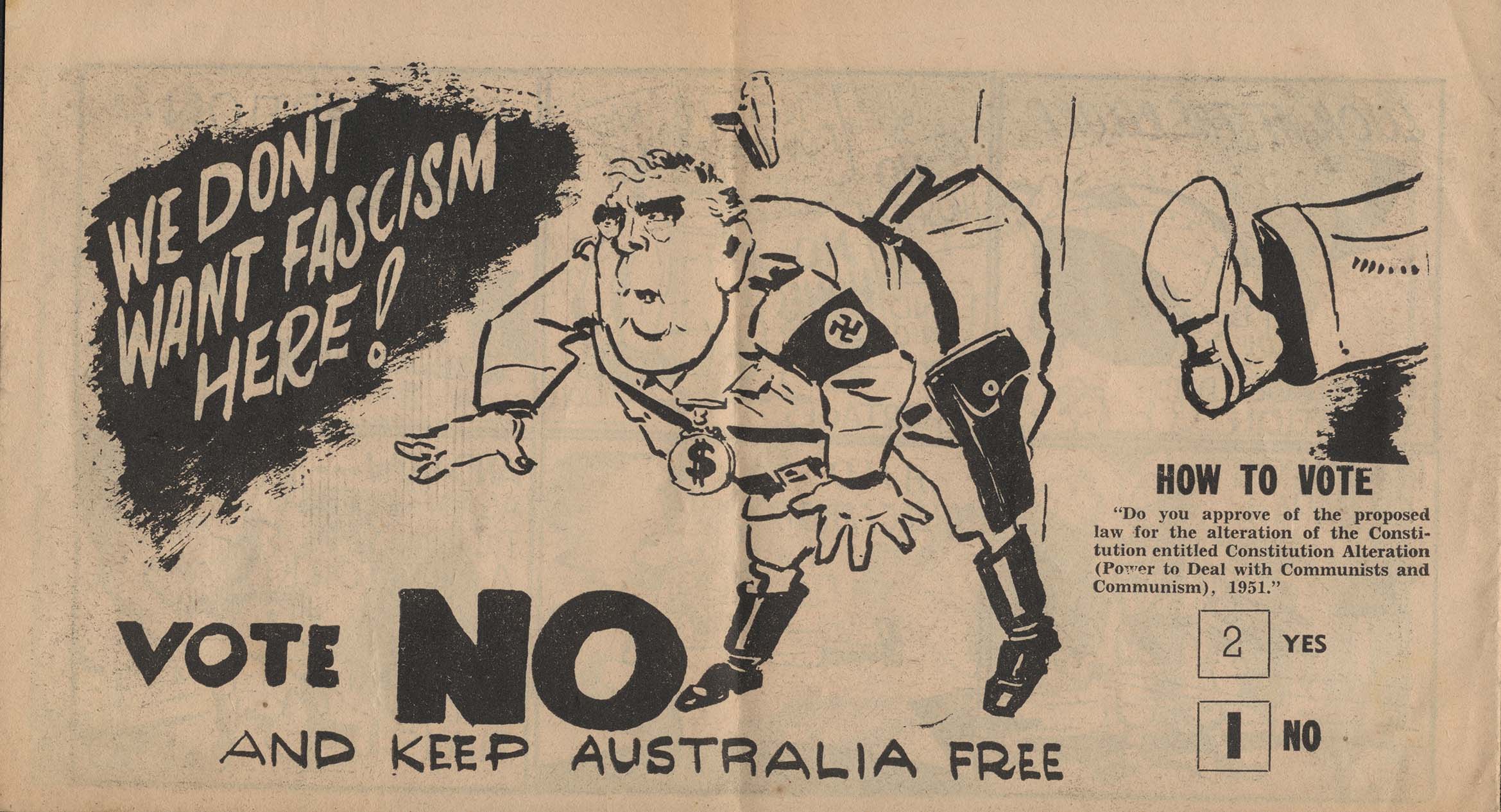
(The Australian people's response to the fascist attempt by Menzies to ban the Communist Party)
The present furore by the Australian Liberal Party about criticisms of its founder, Robert Menzies, carries the hallmarks of those who continue to follow, without question, the basic legacy of a figure portrayed more in line with lower-level, chalk-and-talk, secondary school-type history lessons than with the historical reality. Their seeming inability to comprehend matters arising has been conveniently used to shield them from questionable diplomatic initiatives by Menzies and his associates, which continue to remain highly contentious and problematic.
The pre-War period was marked by a growing concern amongst the business-classes and their political associates about the Soviet Union and its increasing ability to challenge the western countries of the time. Menzies, and his associates, were no exception. The Spanish Civil War of the period provided scenarios which were impossible to ignore. Many figures inside western governments, would have preferred an alliance with Nazi Germany to challenge the Soviet Union, and organised support for such a planned diplomatic initiative. The moves presented serious questions for decision-makers of the time, who preferred to play down the problems which confronted them; political expediency was the order of the day. Present-day studies of that expediency remain an important historical process.
Some British right-wing figures, for example, were clearly colluding with Nazi Germany for that specific outcome; the secret nature of their grand plan carried all the hallmarks of a clandestine intelligence operation. During the mid-1930s, for example, agents of Alfred Rosenberg, who was a prominent Nazi figure in the Third Reich Surveillance Office, travelled to Britain to establish links with supporters and establish the Nordic League. (1) The league was used to then create the Liberty Restoration League (LRL) in 1935, to coordinate far-right, fascist groups and promote Nazism. (2) The LRL subsequently laid the basis for the Right Club which was established in 1939, and attracted secret members, including serving Conservative M.P.s and counterparts in the House of Lords. (3)
Well-placed researchers with access to sensitive documentation about the Right Club have described its role saying it was 'well known that if Britain was attacked they would do everything to encourage a general laying down of arms and the setting up of a puppet state'. (4) The Right Club were 'appeasers' of a certain type; collaborators with Nazism would provide a more apt description of their chosen political and diplomatic standpoint.
The active collusion between the fifth columnists and the Nazi leadership was revealed later, in May, 1941. A senior figure in the Nazi leadership, Rudolf Hess (1894-1987), flew to Scotland on a mission designed to formulate an alliance between Germany and Britain to launch a military assault on the Soviet Union. His flight destination was the Duke of Hamilton's estate. Hamilton had been a member of the Nordic League and had actually travelled to Germany to meet Hess in 1936. (5) Coincidental?
The 235 prominent members of the Right Club were well-placed ruling class figures who were allowed to retain their secret identities until the late 1980s, when their official cover was finally blown. Until that time they, and their descendents lived in a state of denial and challenged the allegations levelled at them as little other than a left-wing conspiracy theory.
Menzies, and his associates, however, had an official diplomatic visit to Nazi Germany in 1938, with the records from the period noting the 'principal object of his visit was to observe the political situation'. (6) It was accompanied with Menzies making the written statement that 'we have no right to dictate what sort of government Germany has'. (7) Following the diplomatic visit Menzies also wrote to his sister declaring 'a degree of admiration for Hitler'. (8) The facts are not in dispute; interpretation, nevertheless, remains contentious.
It would have been inconceivable that the fascist groups operating inside Whitehall and Westminster would not have noted the Menzies diplomatic visit to Germany as a matter of considerable interest. Intelligence and security considerations make complicity inside the corridors of power difficult to prove; the visit to Germany, nevertheless, was openly covered in the newspapers of the day. Diplomatic formalities, however, would have been used as protocol. The trail of interest would also have been noted by the Nazi leadership; they had established extensive world-wide espionage networks to serve their interests. (9)
The espionage networks also included lesser minions who were placed on payrolls for various duties and responsibilities; the aristocratic elite and fifth columnists sought to keep their hands clean, the lesser minions did the dirty work. (10) They should not be overlooked.
The fact that South Australia had a large German community made the Barossa Valley a place of interest for the Nazi leadership. (11) A branch of the Australian Nazi Party was established there in the 1930s. There is no record of Menzies ever having criticised Australian Nazis like he did Australian Communists.
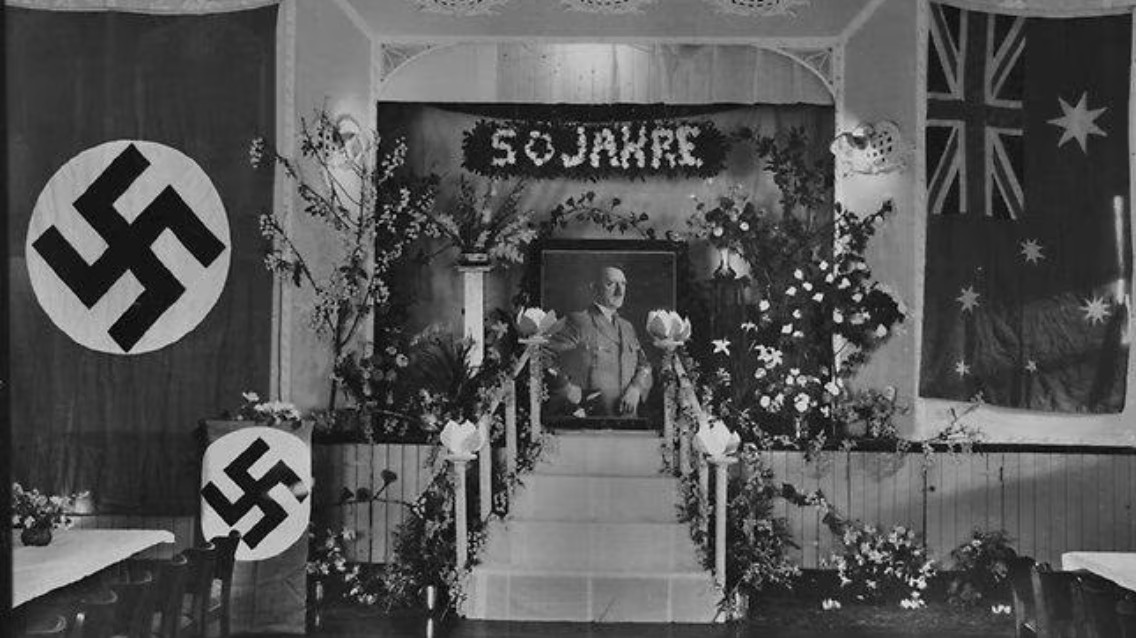
(A 1939 celebration of Hitler’s 50th birthday at the German Club in Tanunda. In 1945, as Germany was nearing defeat, local Nazis held seven separate birthday celebrations for Hitler in South Australia.)
SA Liberal MP Heine Becker, who served from 1970 to 1997, was the son of Dr. Johannes Heinrich Becker, who had emigrated from Germany in 1927. On 1 March 1932, Becker became a member of the German Nazi Party. A year later, he was appointed as the Nazi state trustee (Landesvertrauensmann) for Australia. Becker was eventually promoted to state leader (Landeskreisleiter) of the Nazi Party of Australia. However, his leadership approach did not impress the Nazi top brass in Berlin and he was removed from his post in late 1936. During World War II, Becker was interned in Tatura, Victoria and in Loveday, South Australia. In December 1947, he was deported to occupied Germany. His numerous requests to return to Australia were rejected.
Australia, furthermore, had a strategic significance for the wider interests of the British Empire. Former German colonies on Australia's doorstep in the South Pacific, continued to be regarded as highly sensitive long after their diplomatic demise at the end of the First World War.
The Australian public service of the day, for example, had direct contact inside the British corridors of power with R.G. Casey (1890-1976) who was a liaison officer with the UK, earlier in 1924. He was close to Menzies, being elected as a United Australia Party M.P. in 1931, and treasurer of the party from 1935-39. (12) Interestingly, Casey was elevated to the position of Privy Councillor in 1939; the executive committee of the House of Lords had direct access into Britain's intelligence services and defence and security provision. In that capacity Casey would have had access to MI5 reports and assessments from surveillance of those regarded as a threat to the British Realm. (13)
Baron Casey, as he later became, remained close to the nerve-centres of the Liberal Party for most of his life, holding a number of prestigious political positions. He was highly regarded, but took many of his secrets to the grave. Some may have been highly relevant for our present-day understanding of Menzies and his associates.
In those sensitive positions Casey would also have had access to information about issues arising about Thomas White, who was part of the Menzies delegation to Germany in 1938.
White, who later received a knighthood, was from a military background. Interestingly, following his visit to Germany, he was an official Australian delegate to an international conference in France where the issue of refugees was a main agenda item. White's stated response to the questions about Jewish migration followed the line that Australia had 'no real racial problem, we are not desirous of importing one by encouraging any scheme of large-scale foreign migration'. (14) Such people, however, regarded Aboriginals as 'non-people' and therefore did not acknowledge any discrimination against them at that time.
White was also noted, from a far-right position, to have equated the Jewish refugee problem with that of communism, in line with the stated Nazi position of a 'Jewish-Bolshevik conspiracy'; he wanted all Jewish immigrants to be made to sign a declaration of non-involvement with communists, with deportation being the solution for dealing with the latter. (15)
The position throws considerable light upon the background role of the Menzies right-wing government to make the Communist Party illegal in 1940; the referendum designed to achieve the same goal a decade later, however, proved a disastrous defeat for Menzies. History had moved on; Menzies, and his associates had been left behind.
In conclusion, Menzies, early in his political career during the 1930s, moved in troubled and turbulent times. Making sense of the times involved studying political developments and relying upon the intelligence services for information. The fact Menzies was initially an appeaser is not a matter in question, he clearly was, as documentation has revealed, whatever the reasons and motives for his decisions.
Elsewhere, however, there remain allegations that Menzies made the statement to Liberals in Perth that, 'yes, we should oppose Nazism, but not Hitlerism. Hitler has done a lot for Germany!' The fact that he was not given a senior position in Churchill's Commonwealth War Cabinet, has also fuelled speculation about his chosen position toward fascism. The reason for the decision and question of whether he was regarded by those close to Churchill as not being completely on-side with their position, remains unanswered.
The response of present-day loyal Liberal devotees to the recent criticisms of Menzies has revealed a great deal about their chosen mindset and tenacity; it can hardly be described as straightforward. What are they really hiding behind?
1. Blackshirt, Stephen Dorril, (London, 2007), page 425.
2. Political Violence and Public Order, Robert Benewick, (London, 1969), page 289.
3. The Right Club, Spartacus Educational, September 1997, and, Hitler's aristocratic admirers, The Daily Express (London), 12 September 2015.
4. Wallis, Charles Higham, (London, 1989), page 332.
5. The strange case of Hess and Hamilton, The Education Forum, 25 October 2004, and, Wikipedia.
6. Correspondence: A.T. Stirling to W.R. Hodgson, Germany, Secretary to Department of External Affairs, Memo., H150, London, 3 August 1938, Classified: Confidential.
7. Howard outrage at Liberal icon slur, The Weekend Australian, 4-5 July 2026.
8. Conroy is wrong to call Menzies an appeaser, The Weekend Australian, 4-5 July 2026.
9. See: Hitler's Spies, David Kahn, (London, 1980).
10. See: Spies in Britain, Bernard Newman, (London, 1964), with specific reference to Chapters, 2, 3, 4, 13, 14, and 17.
11. Second World War Nazi agitators in the 1930s, German Australia, with reference to Dr. Johannes Becker (1898-1961) who was a migrant into South Australia in 1927. He was appointed by the incoming Nazi regime in 1933 as an official representative.
12. See: R.G. Casey, wikipedia.
13. How MI5 spied of Britain's wartime fifth column, The Financial Times, 28 February 2014.
14. Sir Thomas White (1888-1957), Australian Dictionary of Biography, John Rickard.
15. Australian participation and performance at the Evian Conference, P.R. Bartrop, MGIMO Review of International Relations, 4 (61), September 2018, pp. 153-167.