VANGUARD - Expressing the viewpoint of the Communist Party of Australia (Marxist-Leninist)
For National Independence and Socialism • www.cpaml.org
US imperialism continues to discuss its plans for warfare in Space. It proceeds from the assumption that “the future warfighting environment is expanding”, and that the potential for conflict comes “from China’s plans for exploring and exploiting the moon.”
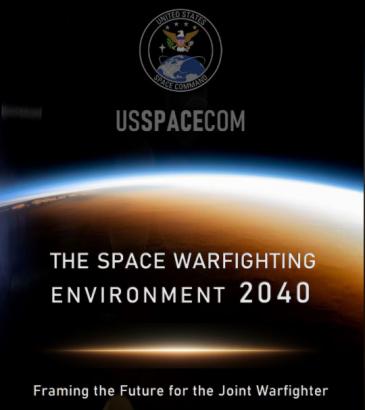
These are direct quotations from a document released in early August by the US SPACECOM.
The paper, titled Space Warfighting Environment 2040, is the first of three SPACECOM intends to release designed to frame “the future of space operations for the Joint Force.” The second document, called “The Space Futures Series,” will provide “issue-driven analysis” of “emerging challenges and problem sets.” The final document, “The Space Warfighting Concept,” will guide how the joint force and SPACECOM “fight and win in space.”
Race to establish Moon base drives Space-fighting
Both superpowers are locked in a race to obtain the commercial and military advantage of being first to establish an inhabited base on the Moon.
China had planned to launch its Long March 5 rocket, carrying the Chang’e 7 robotic mission to the Moon’s south pole in search of water ice on August 19, but the growth and northerly movement of Tropical Depression Narra in the Gulf of Tonkin caused a delay of at least a month and possibly longer depending on the tweaking of the calculations required for a successful launch.
Chang’e 7 will circle the Moon for 90 days to select the best location at its favoured landing site, a permanently illuminated peak next to Shackleton crater at the Moon’s South pole.
In a later article, we will discuss the nature of the competition to secure “first there” advantage between China and the US; it is sufficient now to note that this competition is what is driving the US to hone its space-fighting skills.
US builds command structures for space war
SPACECOM is a US unified combatant command in charge of joint force operations above 100 km (62 miles) in altitude, comprising warfighters from all the military services. The latter combine with SPACECOM in a joint forces command structure.
Serving SPAECOM is a separate command called Space Force, a military service responsible for organizing, training and equipping Guardians to serve under SPACECOM and the other 10 combatant commands. “Guardians” is the name given to those who will do the fighting in Space, just as “sailors” do the fighting on the seas and “pilots” do it in the air.
Space Force released a similar 2040-focused document, called “Future Operating Environment,” by recently retired Chief of Space Operations Chance Saltzman in April.
Both documents focus on cislunar space, the area between the Earth and the Moon, as a domain of emerging military space competition.
The SPACECOM document cites manoeuverability, not just in space but also on the ground, as an area requiring attention. That is, assets sent into orbit around the Earth must be able to break free from their stationary orbital location and be capable of being directed into different locations in cislunar space at speed.
Given that the three components of space war are ground-to-space, space-to-space and space-to-ground, effective space warfare requires manoueverability of land-based assets that communicate with Space.
The US online Breaking Defense website cites the losses suffered by US ground facilities by the Iranians in the current war there as showing “the need to address the vulnerabilities of US satellite ground infrastructure that is based on fixed-site receivers and processing centers.”
The 2040 environment document elaborates: “Static ground nodes, once the norm, will become liabilities. They represent single points of failure that adversaries can attack through cyber intrusion, directed energy, precision fires, or sabotage. In a future where space effects must persist through the first strike, fixed infrastructure will be targeted early and often.”
If the US is anticipating retaliatory attacks following its “first strike” aggression against an adversary’s assets in Space, it would make sense that as much of US satellite ground infrastructure as possible is located outside of the US.
The Force Posture Agreement easily lends itself to the deployment of manoueverable infrastructure such as the GATR Technologies’ portable antenna which dispenses with a rigid dish with heavy-duty structural support and can be quickly packed into cases that are easy to transport and from which it can be quickly reassembled. These systems have already been purchased by the US military and Air Force and could be placed anywhere in Australia under the FPA.
It is essential for Australia’s future security that the hold of the US imperialists over the Australian state be broken, and now.
That means cancellation of the FPA and withdrawal from involvement with any nation in plans for fighting in the “fifth domain” of Space.
It means genuine anti-imperialist independence, and not just a passive declaration of sovereignty, but a contribution to international struggle to defang the imperialists headed by both superpowers.