VANGUARD - Expressing the viewpoint of the Communist Party of Australia (Marxist-Leninist)
For National Independence and Socialism • www.cpaml.org
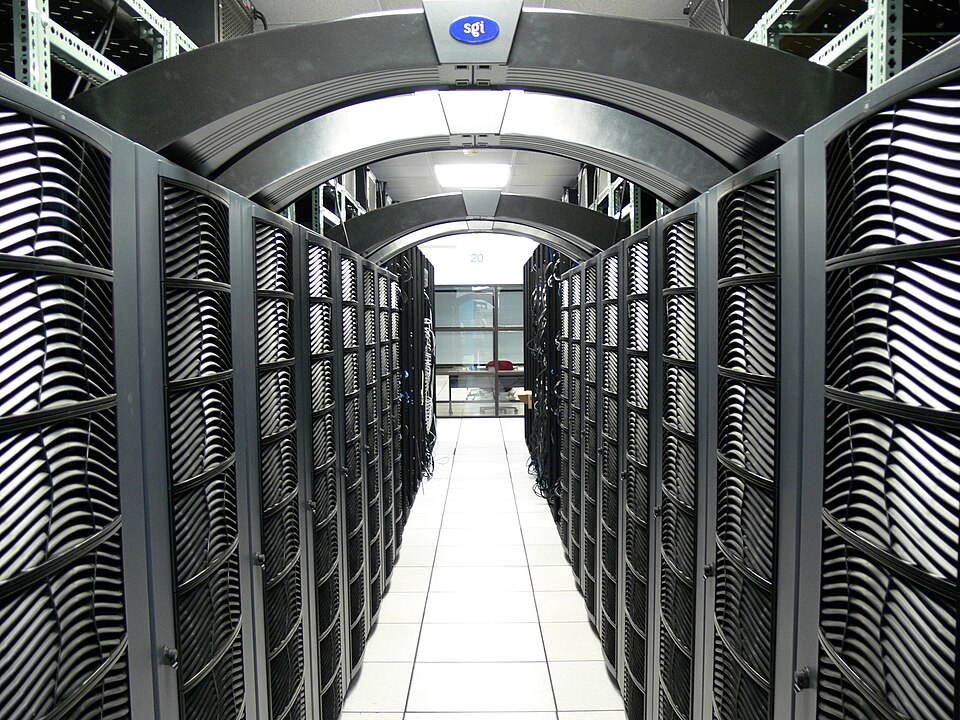
(Data Centre - Creative Commons Attribution-Share Alike 2.0)
The proposed public float of Australian data centre company Firmus in late October is symptomatic of the speculative capital being drawn to the expansion of data centres.
The company hopes to raise $A7.7bn in the largest capital raising by an entrant to the Australian Stock Exchange (ASX), based on a market capitalisation of $A70bn. This will make it bigger than Telstra, whose market cap of $A43bn ranks as the ASX’s biggest listing. (Market capitalisation is the current value of a publicly traded company, based on the total dollar amount that all of its outstanding shares are worth.)
Firmus’s three founders are Oliver Curtis, his father Nick, and Tim Rosenfield who own 13 per cent, 5.6 per cent and 5.4 per cent respectively. US private equity Blackstone owns 6.7 per cent. US technology giant Nividia owns 7.2 per cent.
Firmus' three founders will be able to sell hundreds of millions of dollars of shares 12 months after the data centre developer lists in the largest ASX float on record, and can offload another 30 per cent of their stake a year later.
The Firmus prospectus reveals Mr Curtis and Mr Rosenfield are paid $US1.6m annually in fixed salary, are entitled to receive a short-term incentive of up to 180 per cent of their base salary for next year and long-term incentive worth up to 270 per cent of base salary up to June 2029.
Investors who will be putting their money into Firmus shares will be making a claim on future profits from the surplus value accruing to the company. How that surplus value is created in an industry with few employees whose labour power is the sole source of surplus value will be investigated in a later article.
The investor speculation gambles on Firmus’s ability to grow quickly as a publicly listed company.
Its only two operational data centres at present are a 5 megawatt facility in Singapore and a 42MW centre operating in a building owned by CDC Data Centres in Melbourne. It has received development approvals from the Tasmanian government for two more. Two other centres in SA are proposed for Stirling North (near Pt Augusta), and Tailem Bend on the Murray River.
Investors will need to be convinced that the community supports, or at least tolerates, the existence of data centres in their backyards. The Australian reported that “There’s talk that all of its support so far has come from the US, with Asian investors as equally wary of the deal as Australians. Sources say American investors are willing to take a bet on the transaction because gaining data centre development consent is becoming increasingly more difficult across the United States as the population pushes back on construction of data centres near residential areas and as excess power supply to operate them becomes more limited.”
Firmus claims it can achieve pre-tax profit margins of 90 per cent across its artificial-intelligence data factories, far eclipsing those of powerhouse mining giants BHP and Rio Tinto.
Reserve Bank governor Michele Bullock is not yet convinced, saying on Tuesday that central banks around the world were “all a little bit worried” that the AI investment boom could be a bubble. That is, there is the strong likelihood that what Marx termed “fictitious capital” – capital placed into shares and bonds separated from actual production – will be massively devalued if later surplus value creation fails to materialise.
Capitalism is an inherently anarchic economic system and is incapable of systematic planning to meet the real needs of the people.
Socialism will put an end to the speculative waste of capital that should be employed for socially useful purposes.
Further reading: Financialisation: fictitious capital and its real impact. (booklet)