
US submarine visits not welcome and will never be “normal”
Written by: Nick G. on 25 March 2024
On Sunday March 10, the US Los Angeles class submarine, the USS Annapolis, arrived at the Stirling Naval Base in WA from its home base in Guam. The date signified the first anniversary of the signing of the AUKUS arrangements. Rallies in Australia cities were held to oppose AUKUS.
The visit was primarily a propaganda exercise designed to normalize the presence of foreign submarines in Australian waters. The propaganda exercise included a “gridiron friendly” between the US submariners and a WA state team.
Under the AUKUS Optimal Pathway program, up to 4 U.S. Virginia-class submarines and one United Kingdom Astute-class submarine will use HMAS Stirling as a rotational base. The Submarine Rotational Force – West (SRF-West) will operate on the same principles as the US marine rotational base near Darwin, and see more than 700 American personnel at the WA base to support the submarine presence.
The Australian government has announced expenditure of $8 billion to upgrade Stirling’s facilities. According to a March 21 report in the US online Breaking Defense Indo-Pacific, Stirling “needs to be enlarged to cope with larger Virginia-class sub visits and must be secured to meet US and UK standards for protecting nuclear secrets and equipment.”
The $8 billion is on top of the $9.4 billion already gifted to US and UK companies in preparation for building nuclear-powered submarines that will be an Australian appendage to the US Navy as it sits off the coast of China and threatens war with that country.
The US lackey and Prime Minister of Australia, Albanese, claims that once the AUKUS submarines are in operation they will fly the Australia flag and be under Australian sovereignty.
That is not how the US sees it. Former independent SA Senator and submariner Rex Patrick tweeted the text of the conditions under which the US sale of Virginia-class nuclear-powered submarines will take place.
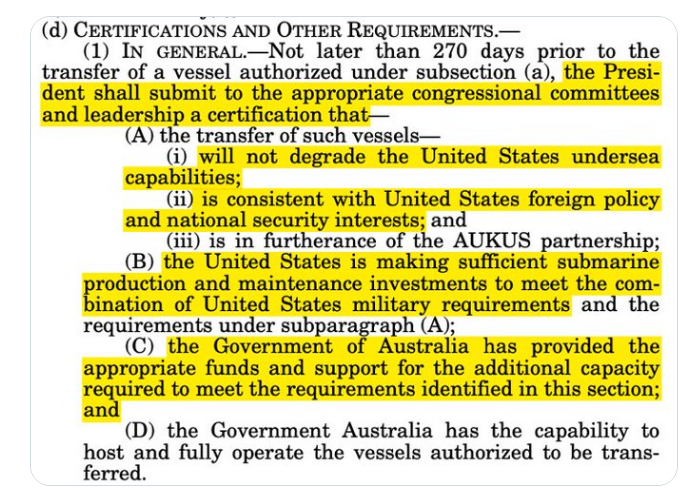
They require their use to be “consistent with United States foreign policy and national security interests.” In other words, not the coastal defence of Australia, but deployment off the coast of China.
And, as is now widely known, the sale is provisional on the US having enough submarines for its own imperialist military requirements. Having enough for itself to release second-hand Virginias to Australia requires an annual US production of 2.3 submarines a year.
But the US has just reduced its submarine production to 1 submarine per year, much to the embarrassment of Albanese and Marles.
Hopefully, the program will collapse under the weight of its own stupidity.
But much more likely is that it will need to be swept away by continuing people’s actions.
Print Version - new window Email article
-----
Go back
Articles
| Pax Silica, the Philippines and US war preparations against China |
| Imperialism and the Australian State |
| Imperialism and the Australian State |
| Pauline Hanson is no friend of Farmers |
| How Maoists were treated commemorating the 50th death anniversary of Chairman Mao |
| New Zealand is being drawn into US plans to achieve military supremacy in space. |
| The U.S. government, the Pentagon and big tech: key components of U.S. imperialism. Part 2: The Pentagon and Big Tech’s intimate relationships. |
| Notes on Barbarism – The Manifestation of Barbarism with the Decline of US Imperialism |
| BOOK REVIEW: MUSKISM - A GUIDE FOR THE PERPLEXED |
| Marles, you pathetic lackey - No more US military in Australia! |
| Break the hold of the US on the Australian state |
| ICOR Statement: Fight for peace, international solidarity, and against fascism! |
| The Henderson warfare target |
| US-ROK Freedom Shield and other tensions |
| Race to colonise the Moon sees more space war planning |
| The forked tongue of US policy on the Asia Pacific |
| Impact of Russian Revolution on Labor Party In Australia |
| The Trump Administration and the scramble for the Pacific sea-bed |
| US developing kinetic and non-kinetic weapons for space war |
| The U.S. government, the Pentagon and big tech: key components of U.S. imperialism. Part 1 |
-----