
Fleurieu Peninsula marine deaths a sign of global warming’s existential dangers
Written by: Nick G. on 12 April 2025
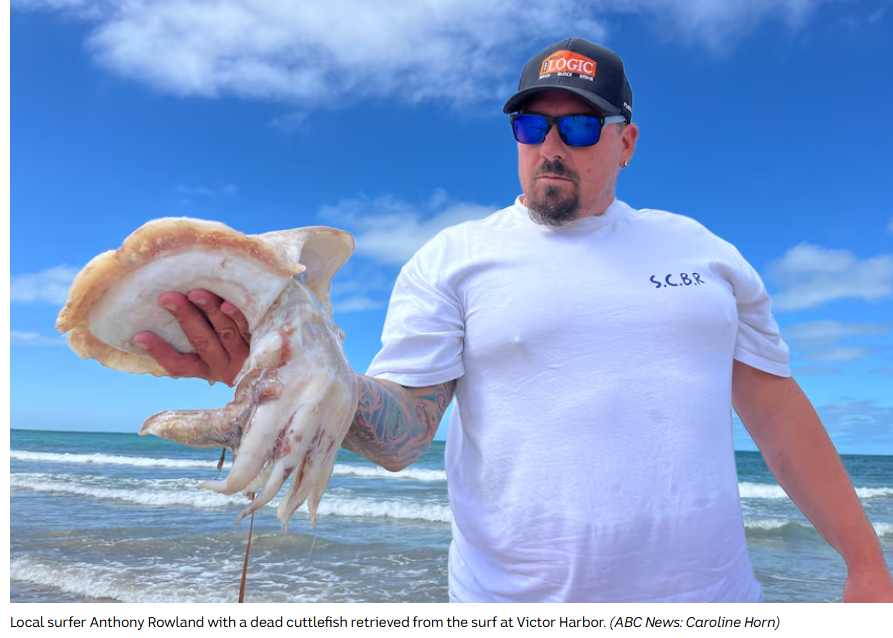
South Australians are in the grip of a “canary in the coal mines” moment, although it is not a canary and it is not a coal mine.
In early March, suffers at the popular South Coast beaches of Waitpinga and Parsons reported suffering headaches, coughing, skin rashes and blurred vision, whilst the beaches themselves began to be littered with masses of dead marine life. A sludgy thick brown foam began to accumulate along the shoreline.
The two beaches were closed by the Environmental Protection Authority which, after some time, declared that a species of microalgae, Karenia mikimotoi, was responsible.
The marine life washing up on the beaches, which soon included some on Kangaroo Island, and around the corner of the Fleurieu Peninsula at Encounter Bay, Victor Harbor and Bashams Beach, included the less attractive toad fish (aka the puffer fish) and the incredibly attractive tourist icon, the leafy sea dragon. They included a variety of reef fish, octopi and sea slugs.
The devastation has spread across Gulf St. Vincent to places like Edithburgh on Yorke Peninsula. Underwater photographer Paul Macdonald, who has been diving at Edithburgh for "almost 30 years", said he went diving on the weekend but was heartbroken by what he saw.
"Pretty much everything was dead, it was really heartbreaking," he said.
"We could see the water wasn't quite right, it was a brown-y colour with no visibility.
"It was just devastating to see very few fish around, pretty much everything that we did see was dead or in the process of dying."
Just six days ago, as the EPA was preparing to reopen Waitpinga and Parsons, the marine deaths extended further along the coast in the direction of the Coorong, with tens of thousands of cockles (aka pipis) and other shellfish washing up on beaches around Goolwa.
Goolwa has an annual seven-month cockle season from 31 October to 1 June when anyone can harvest cockles (bag limits apply) either for personal consumption or for fish bait. SA Health has advised people not to eat dead cockles.
But with reports that the toxic bloom appears to be spreading south of the Coorong to Kingston in the South-East, the recreational fishers' peak-body Recfish SA, says that close to 200km of coastline will be impacted by the latest die-off, and the deaths will be in the millions, “unfathomable amounts”. A spokesperson said marine deaths along the coastline were now at an unprecedented scale.
Global warming and increased frequency of toxic blooms
In the current lead-up to the federal election, there is necessarily a concentration on the soaring cost of living. However, there is also the cost of living on an increasingly warming globe due to profit-hungry corporations continuing to use fossil fuels.
Toxic algal blooms are increasing in scope and intensity around the globe. So are extreme weather events. Warmer oceans produce more evaporation leading to unprecedented rainfall events. Droughts are longer and temperatures are rising.
South Australians watch in awe as parts of Queensland and New South Wales are flooded with daily downpours of hundreds of millimetres. Suburban Adelaide meanwhile has only had 29mm over 4 and half months: 14mm over 4 days in December, 3.5mm over 2 days on January, 0.5mm on one February day, 9.5mm on one March day, and 1.5mm so far on two days of April.
Summer temperatures and the minimal disturbance of the sea by winds pushed ahead of large rain-bearing clouds create the perfect conditions for the growth of algae. The EPA described it as “an ongoing marine heatwave, with marine water temperatures currently 2.5C warmer than usual, as well as relatively calm marine conditions with little wind and small swell.”
They are not infrequent, but they are getting worse, a factor that many scientists attribute to climate change. They have happened along 200 miles of Florida coastline in 2018, and in 2020 along Russia’s eastern coast.
Many algal species flourish when water circulation is low and water temperatures are high.
The blooms can last from a few days to many months. After a bloom dies, the microbes which decompose the dead algae use up more oxygen, which can lead to die-offs of fish and other marine organisms. When these zones of depleted oxygen cover a large area for an extended period of time, they are referred to as dead zones, where neither fish nor plants are able to survive.
So long as capitalism incentivises large corporations to put profits from fossil fuels ahead of people and the environment, the cost of living on a planet that is dangerously warming will rise in tandem with the temperatures.
Capitalism’s destructive war on nature must be ended.
Socialism is urgently required to enable harmony between people and nature.
Print Version - new window Email article
-----
Go back
Articles
| Transdev bosses are spewing, but oh, so politely, as they take on MUA ferry workers in Sydney |
| Visiting US Congressman reveals a few home truths |
| Condemn the US placement of weapons in Outer Space |
| Government "Rescue Package" NO SECURITY FOR WHYALLA STEEL WORKERS |
| Data Centres and AI: has the horse already bolted? |
| Pax Silica, the Philippines and US war preparations against China |
| Imperialism and the Australian State |
| Imperialism and the Australian State |
| Pauline Hanson is no friend of Farmers |
| How Maoists were treated commemorating the 50th death anniversary of Chairman Mao |
| New Zealand is being drawn into US plans to achieve military supremacy in space. |
| The U.S. government, the Pentagon and big tech: key components of U.S. imperialism. Part 2: The Pentagon and Big Tech’s intimate relationships. |
| Notes on Barbarism – The Manifestation of Barbarism with the Decline of US Imperialism |
| BOOK REVIEW: MUSKISM - A GUIDE FOR THE PERPLEXED |
| Marles, you pathetic lackey - No more US military in Australia! |
| Break the hold of the US on the Australian state |
| ICOR Statement: Fight for peace, international solidarity, and against fascism! |
| The Henderson warfare target |
| US-ROK Freedom Shield and other tensions |
| Race to colonise the Moon sees more space war planning |
-----