
BOOK REVIEW-: The AI Con: How to Fight Big Tech’s Hype and Create the Future We Want
Written by: Alex M and Duncan B on 21 February 2026
We are part of a group of comrades who have been studying AI, trying to understand it and its likely effects on the working class. We have been reading various books about AI, discussing them, and writing reviews for Vanguard. We have also read many articles about AI in the daily press and on-line. It is easy to get sucked in by all the hype surrounding AI coming from both the promoters of AI, the “Boosters,” and those concerned with the catastrophic potential of artificial general intelligence (AGI), the “Doomers.”
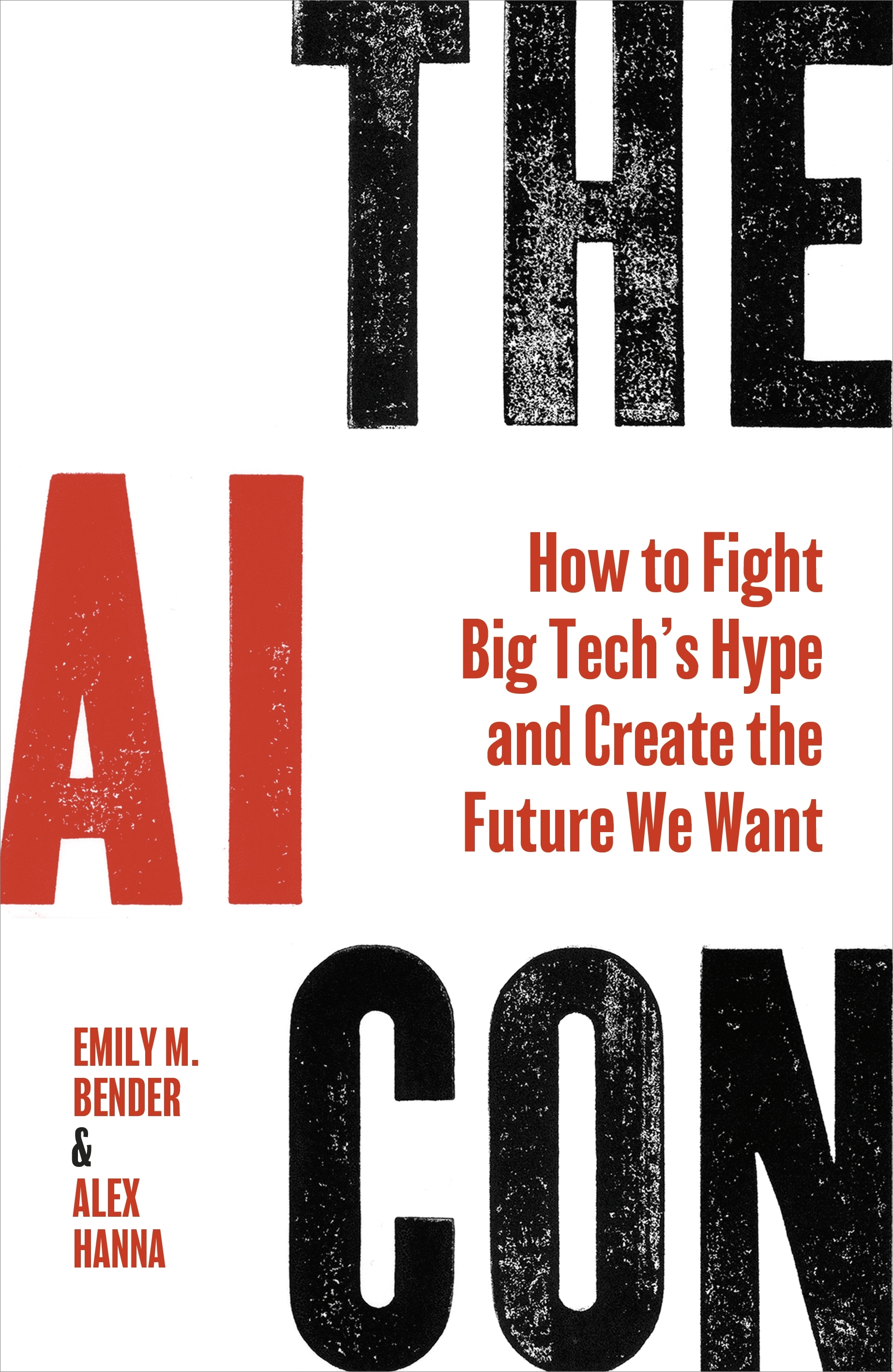
The AI Con: How to Fight Big Tech’s Hype and Create the Future We Want by Emily M Bender and Alex Hanna is an excellent antidote to all the hype around AI. Dr. Bender is a Professor of Linguistics at the University of Washington. Dr. Hanna is Director of Research at the Distributed AI Research Institute and a former senior research scientist on Google’s Ethical AI Team.
The aim of the book is to help people become resistant to the hype surrounding AI. The authors have this to say about AI. “Artificial Intelligence, if we are being frank, is a con: a bill of goods you are being sold to line someone’s pockets.” They see “Artificial Intelligence” as a marketing term that doesn’t relate to a coherent set of technologies. The people selling technology labelled as “Artificial Intelligence” are trying to convince us that their technology is similar to humans, able to do things that require human judgement, perception or creativity. The authors want to educate people how “AI” systems work, dispel the notion that they are thinking machines with a semblance of human understanding, and to provide a model of how to think about them instead.
Technologies sold as AI can perform various functions such as decision making, classification of inputs, making recommendations, transcription or translation of text or speech and text and image generation.
The authors recognize that there are beneficial applications of machine learning and give some examples of these. However, for every beneficial application, there are dozens of applications of AI that are harming people.
These include people who have suffered harm due to bad decisions by automated decision-making systems, (think Robodebt), people (mainly black), wrongly identified as criminals by police facial recognition systems and women who are the victims of deep fake pornography. Then there are the workers whose jobs are under threat in movie making, journalism, social services, the arts and science and many more occupations.
Ever since the Industrial Revolution began, capitalists have used automation to get rid of jobs. Today’s capitalists are pinning their hopes on AI to get rid of jobs in the same way as the 19th century mill owners did. The authors say, “While executives suggest that AI is going to be a labour-saving device, in reality it is meant to be a labour-breaking one. It is intended to devalue labour by threatening workers with technology that can supposedly do their jobs at a fraction of the cost.” In volume 1 of Capital, Marx described how the capitalists of his day used the new technology of machinery to threaten workers and break their militancy. How little has changed!
The authors criticize both the “Boosters” and the “Doomers” and show that they are two sides of the same coin, both camps seeing AI as inevitable and desirable. The “Boosters” make incredible claims for the alleged benefits of AI.
For example, Amazon Web Services recently ran full page advertisements in the daily press (Melbourne Age 11/1 and 12/1/26) promoting “Generative AI”. The use of this technology in medical research will shorten by 15 years the time for people with epilepsy to become seizure-free, according to the Australian Epilepsy Project.
Businesses will be able to use new “frontier agents”, described as “AI technology designed not just to assist, but to autonomously manage complex tasks for hours or even days at a time, freeing up workers to focus on more strategic, impactful-or just more fun-work.” Other applications include chatbots that can hold proper conversations with customers in over 30 languages.
The “Doomers” try to scare us with dystopian visions of a world where humans are exterminated by superintelligent AI systems. (Eliezer Yudkowsky, one of the authors of If Anyone Builds It Everyone Dies, is a “Doomer.”)
Both “Boosters” and “Doomers” divert attention from the real and present dangers posed by AI as it exists now, and try to get us worrying about an AI future that may never happen. They ignore the damage being done to the environment by the rapid development of data centres and their massive use of electricity and clean water.
The authors advance some strategies to help ordinary people deal with the onslaught of AI hype. We need to become more informed about AI and question the alleged benefits of AI and protest about the misuse of AI applications.
The authors urge that existing regulations about AI should be enforced and that further appropriate regulations should be enacted. As we have said before, we hold out little hope of this when AI is controlled by Musk, Altman and co. in a US ruled by Trump.
There have been hundreds of books written about AI and millions of words. The AI Con will help us cut through the hype to understand the benefits and dangers of AI.
**************************
As Duncan B has made abundantly clear above, it is important for us to see through the piles of hype associated with AI, and Emily Bender and Alex Hanna have done a wonderful job in helping us to do so. Their book is thus highly recommended.
I would like to just tease out some more on one area in particular that Duncan’s review has touched upon namely the role that “Boosters” and “Doomers” play in diverting attention away from the major problems facing the world right now, rather than some possible dystopian future. Bender and Hanna succinctly summarise what they call the two sides of one coin, that is, the characteristics of the “Boosters” and “Doomers”. On one side of the coin, the “Boosters” promote the benefits to humanity that supposedly flow from the application of AI in various fields of work. On the other side are the “Doomers” who believe that at some point in the not too distant future, AGI will become sentient and have interests and preferences at odds with humanity and will seek to supplant humanity, possibly leading to our extinction as a species. The substance of the coin, the common element that binds the “Boosters” and “Doomers” together Bender and Hanna state: “… is the belief that the development of AI is inevitable and that the resulting technology will be both autonomous and powerful, and ultimately beneficial if we play our cards right.” (Bender and Hanna, p. 138)
Furthermore both “Boosters” and “Doomers” overlook or downplay “… the real harms of actually existing automation, at best dismissing them as less important than the imaginary existential threats.” (Bender and Hanna, p.139) For Bender and Hanna the “totality of systems sold as AI” has led to financial speculation, “the degradation of informational trust and environments, the normalization of data theft and exploitation, and the data harmonization systems that punish the people who have the least power in our society by tracking them through pervasive policing systems.” (Bender and Hanna, p.152) Added here should be the insidious application of AI into US and Israeli military software systems that have contributed to the thousands of deaths of Palestinian civilians. (In fairness to Bender and Hanna they do mention the IDF’s use of an AI enhanced targeting system in Gaza on p.4 of their book but that is in passing. The increasing use made of AI by the militaries of the Zionist state and US imperialism is outside the scope of their book)
Another part of the hype surrounding AI is the myth that workers will be both more productive and be freed from the more onerous parts of their work. A win-win for employers and employees. Such big promises have been a feature of technological innovation for a long time:
From the start of the Industrial Revolution, workers have had to contend with displacement via automation and have resisted it for just as long. One of the hallmarks of the beginning of this age was the concomitant rise of innovative technologies advertised to make work easier and simpler, and to increase productivity. Like modern AI boosters, those selling new technologies promised that they would usher in a rising tide that lifted workers and business owners alike. But that is just a fiction whose function is to sell the technology. Automation has always been part of a larger strategy of shifting costs onto workers and accruing wealth for those in control of the machines. (Bender and Hanna, p. 43)
More could be said about this important hype busting book, but for now, this will suffice.
If you want to read one critical AI book that cuts through the hype then read this book.
Print Version - new window Email article
-----
Go back
Articles
| The April 9, 1948, Massacre in a Palestinian Village and the Killing of Peace in Palestine |
| BAE Systems in South Australia targeted by Anti-War Protestors |
| Award wage increases are not "trivial" |
| Nazis disband but far-right continues to organise |
| Book Review: The Immortalists |
| South Korea to host US data-centres and mass surveillance |
| HACM: Missiles Miss Their Target |
| BOOK REVIEW-THE PHILOSOPHER IN THE VALLEY |
| Teachers say “Time to fight!” |
| TRUMP’S WAR ON IRAN WILL HURT AUSTRALIAN AGRICULTURE |
| The Ever-Increasing Foreign Ownership of Australian Agriculture |
| Reflections on the movement to oppose the war against Iran |
| Learn from the revolutionary spirit of Comrade Zheng Huilu |
| Workers' struggles in Australia intensify - make the rich pay |
| ICOR Statement: The U.S.’s Murderous Oil Embargo Against Cuba |
| Zionism: regional expansion in pursuit of a Greater Israel |
| Book Review: If Anyone Builds It, Everyone Dies: The Case Against Superintelligent AI by Eliezer Yudkowsky and Nate Soares |
| Solidarity with the Revolutionary Socialists in Turkey |
| Anti-War Protestors Invade Premier Malinauskas' Electoral Office |
| The significance of Diego Garcia for the US |
-----