
Can the US withstand the BRICS challenge?
Written by: (Contributed) on 27 May 2026
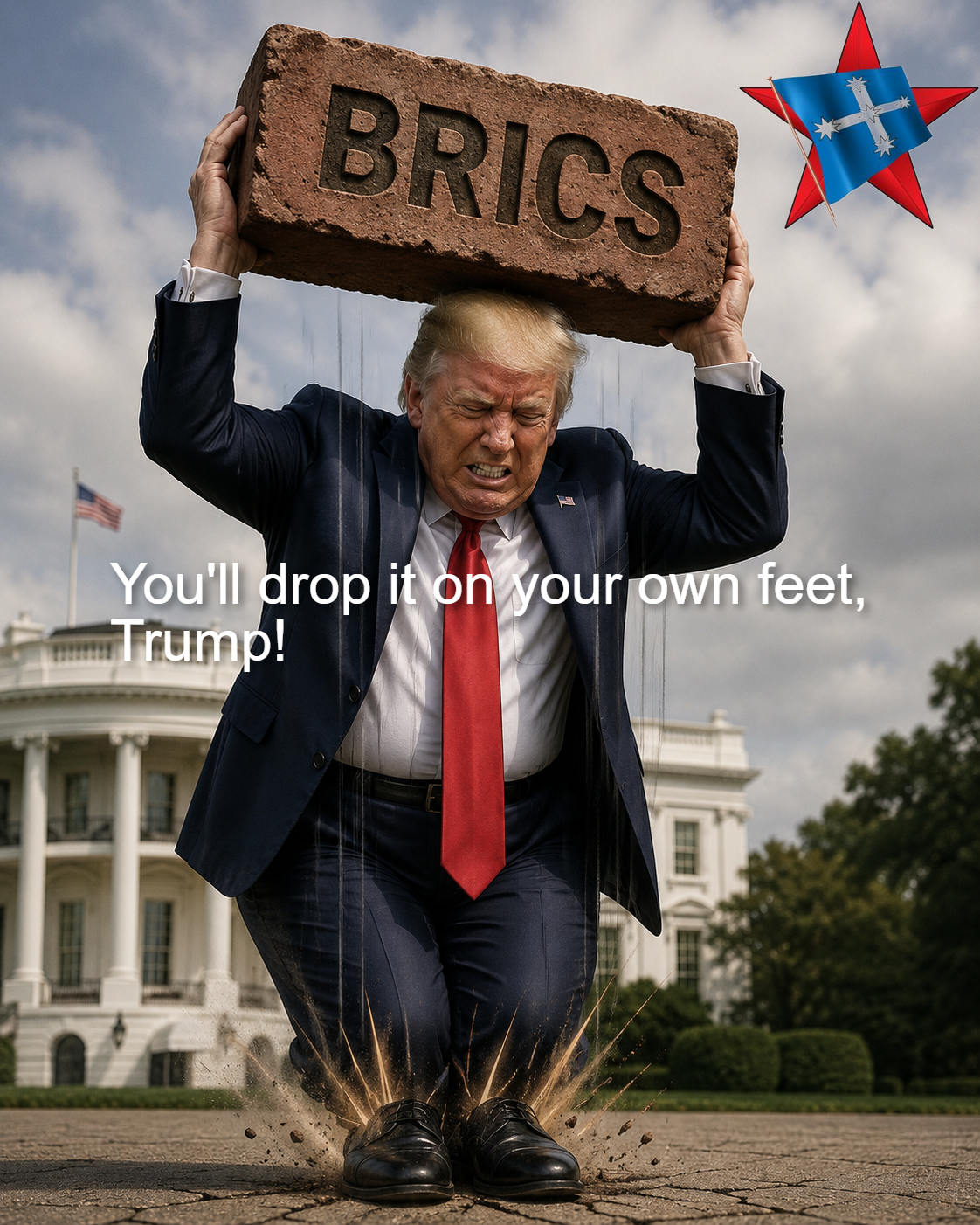
(AI generated image)
A carefully worded media release from BRICs has revealed the transition toward a diplomatic collective is well under-way. The trade body, now increasing its influence in the emerging economies of the South, has presented a credible challenge to traditional US hegemonic positions and that of their allies, which seek to reassert traditional hegemonic positions by controlling strategic supply and trade routes central to BRICs.
During mid-May, when sensitive negotiations were taking place over the US-Iran war, BRICs issued a major diplomatic statement advocating peace initiatives. (1) It emerged from a collective meeting of foreign ministers from the trade organisation, meeting in New Delhi. The statement, led by Indonesian foreign minister Sugiono, was the outcome of an assessment of present-day problems, 'that unilateral actions, selective enforcement of international law and intensifying geopolitical rivalries, were pushing the global order into deeper crisis'. (2) It was a classic diplomatic analysis of the present Cold War.
While the Trump administration was not openly named, there was little ambiguity who Sugiono was identifying as the main problem. Strict diplomatic protocol, however, was the order of the day.
The BRICs trade body, composed of ten full members together with associates, now represents nearly half of the world's population, and about 40 per cent of global GDP, together with 24 per cent of global trade and approximately 72 per cent of global reserves of rare earths. (3) China, furthermore, has come to dominate the BRICs organisation. (4)
The transition from a trade body to one which exerts considerable diplomatic influence has already taken place. One of the main objectives of BRICs, moreover, has been the encouragement of members and associates to allow 'developing countries to voice their concerns and interests'; diplomacy has accompanied trade considerations. (5) Many countries have already made use of the opportunity.
The fact that BRICs members and associates are often members of other trade bodies has enhanced its standing inside the corridors of power in many countries, some of which are highly geo-political and strategic for traditional US hegemonic positions and supply-lines.
The peace negotiations between the US and Iran, for example, have become increasingly diplomatically focused upon Saudi Arabia, the UAE and Qatar. While the first two are BRICs members, all three form part of the Gulf Co-operation Council (GCC). The council holds considerable influence inside many countries in the Middle East. The recent decision taken by Oman, for example, a highly geo-strategic country near Iran, to not join the Trump administration's so-called Board of Peace was taken on the basis they were in solidarity with the GCC. (6)
While the US, however, seeks to retain favourable diplomacy in the Middle East, the changing nature of the balance of forces and their diplomatic isolation has already weakened their hegemonic position.
BRICs, furthermore, has been surpassed the US; reliable trade statistics recorded the US amassed 12.9 per cent of global GDP last year, projected to drop to 11.8 per cent by the end of the decade. (7) It is likely to drop still further, in a downward spiral, in future decades.
Recent US hostilities toward Iran, together with Venezuela and Cuba, therefore, are best viewed as an attack upon the wider BRICs. Iran became a full member in January, 2024, Cuba became an associate member in January, 2025. Venezuela, likewise, has had a long association with BRICs, although their troubled diplomatic relations with Brazil prevented full membership.
Behind the scenes, however, the US remain focused upon China: It is the world's biggest importer of oil; the US seek to control the supply lines and trade routes. The fact that China does not tend to use the US-backed petro-dollar has become a serious blow to their economic supremacy of yesteryear and the Monroe Doctrine.
The BRICs summit, scheduled for October in India, likewise, has already published a main agenda item which has included discussion on alternative currencies to the petro-dollar.
In the lead-up to US military attacks on Iran, it was exporting about 90 per cent of crude oil to China.
China was also a major importer of Venezuelan crude oil, which it secured at reduced prices due to the large-scale of the exports from Caracus, and often shipped via Cuba. In the lead-up to the recent US seizure of control, it is thought Venezuela was exporting at least 75 per cent of its oil to China, with a surplus for use in Cuba. Washington and the Pentagon appear to be following a foreign policy of attempted strangulation toward Beijing's strategic resources.
In conclusion, US diplomatic and military hostilities with Iran, Venezuela and Cuba can best assessed as attacks on the periphery of BRICs, while China remains the central adversary.
1. BRICs tension over Mid-East crisis, The Weekend Australian, 16-17 May 2026.
2. Ibid.
3. See Official website: BRICs – Brazil, 2025.
4. China continues to dominate an expanded BRICs, The East Asia Forum, 12 April 2024.
5. Ibid.
6. See: Oman FM., Middle East Monitor, 12 March 2026; and, Emirati Veto and Omani reservations, website - People Want, 13 May 2026.
7. See official website: World Economics, US share of global GDP.
Print Version - new window Email article
-----
Go back
Articles
| Contradictions and conflicts in the race for Space |
| Can the US withstand the BRICS challenge? |
| Fight the Militarisation of Space |
| Fight the militarisation of space |
| SA nurses, midwives to resume industrial action |
| Australian data-centres to serve US Techint |
| ICOR Statement on Nakba Day, May 15, 2026 |
| The US War Budget and the Pacific (Pt. 1) |
| Nationalise Australian Ports! |
| Nationalise Australian Ports |
| Campaign for a gas export tax and Albo flinches |
| ICOR declaration: Resolute Solidarity with the Cuban People Against the Sanctions and Threats of U.S. Imperialism |
| Vanguard May Day 2026 |
| A Tale of Two Imperialisms – Part 2 |
| Exercise Balikaton, Philippines, 2026: the relevance of the so-called 'Squad' |
| Elections Within Unions and Their Limitations |
| Financialisation: fictitious capital and its real impact |
| Imperialism's "Global Supply Chains" Exposed |
| A Tale of Two Imperialisms |
| Australia’s 2026 Defence Strategy: Last gasp of US empire loyalists? |
-----