
Oppose the extraterratoriality of NATO personnel in Australia.
Written by: Nick G. on 31 July 2026
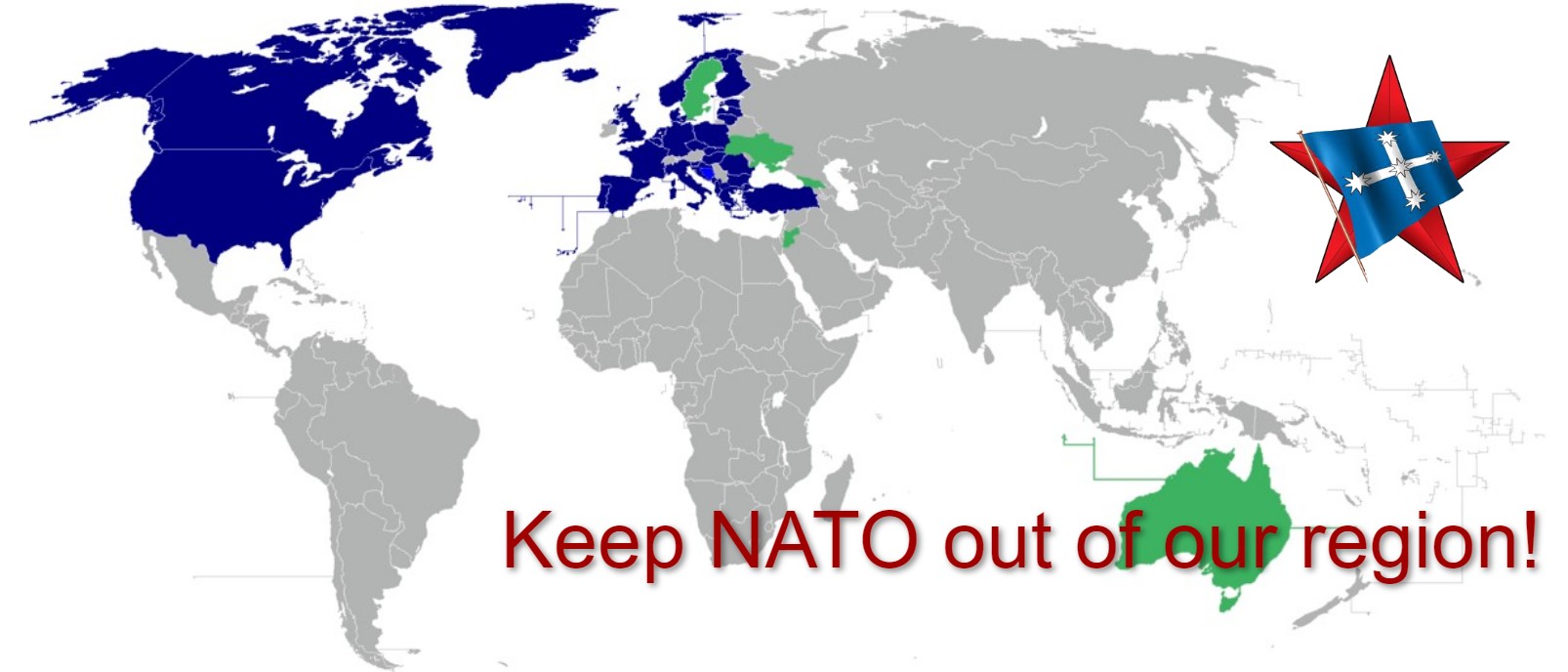
A proposed new Agreement governing the deployment of NATO personnel to Australia to facilitate the procurement of NATO goods and services is setting a dangerous new precedent for the surrender of Australian sovereignty.
Specifically, it proposes extending near-extraterritorial status to all civilian and military NATO personnel operating in Australia. Extraterritoriality was notoriously imposed on Qing Dynasty China by Western powers whose citizens in China could not be tried for crimes in Chinese courts, and large sections of Shanghai were denied to Chinese police and military.
Australia has several agreements governing the status of visiting foreign military personnel. They are the Defence (Visiting Forces) Act (1963), the Australia–United States Status of Forces arrangements (1963), and the Australia–United States Force Posture Agreement (2014) governing the rotational deployment of US Marines, Air Force personnel and other forces in Australia.
None of these provide complete exemption from Australian law, although they do provide for jurisdictional allocation where Australia can agree to provide waivers from prosecution under Australian law, and allow the prosecution of those charged by the military authorities of the foreign state concerned. This is particularly the case where conduct constitutes an offence under both Australian law and the sending country's military law, and both countries may potentially have jurisdiction.
US-Australia Force Posture Agreement
The most significant waiving of Australian immunity to date applies to US military personnel under the Force Posture Agreement which confirms that US personnel remain subject to US military law while also recognising Australian criminal jurisdiction in appropriate cases.
The FPA does not relinquish legal Australian sovereignty to the US for its bases in Australia, but does so in practice. Within Australian bases, certain areas may be designated for the exclusive use or control of US forces for agreed purposes. Operational control of designated areas may rest with the US during agreed activities. This concept did not exist in the same developed form under the Visiting Forces Act.
Article VII of the PFA states:
“United States Forces and its contractors shall have unimpeded access to Agreed Facilities and Areas for all matters relating to the pre-positioning and storage of defence equipment and supplies including delivery, management, inspection, use, maintenance and removal of such pre-positioned material. As mutually determined by the Parties, aircraft, vehicles and vessels operated by or for United States Forces shall have access to aerial ports and sea ports of Australia and other locations, for the delivery to, storage and maintenance in, and removal from, the territory of Australia of United States Forces’ pre-positioned material.”
In short, the Agreement enables the United States not only to station its troops in Darwin but to store on Australian soil, US war supplies including spare parts, fuel, weapons, ammunition and bombs and opens Australia’s seaports to their navy and airports and runways for the use of their air-force.
The NATO Agreement
The full title of the proposed new Treaty is the Agreement between the Government of Australia and the North Atlantic Treaty Organisation (NATO) Support and Procurement Organisation (NSPO) on Acquisition and Support Cooperation.
It has so far largely slipped under the radar. It was opened for public inquiry by the Joint Standing Committee on Treaties, but as of the closing of the time for submissions, there had only been two, one strongly for the Treaty, and one strongly against. By contrast, the non-Parliamentary Public Inquiry into AUKUS, which is still ongoing, has received nearly 500 public submissions to date, almost every one of which is opposed to the AUKUS arrangements.
Under Article 5.3 of the NATO Treaty, the NATO Support and Procurement Organisation (NSPO) “shall have legal personality within Australia…”
Under Article 6.3, “NSPO shall enjoy immunity from any jurisdiction including criminal, civil and administrative, in Australia.” Under Article 6.5, those immunities include:
a. Immunity from personal arrest or detention, and inviolability of papers and documents;
b. Immunity from suit and from other legal process in respect of words spoken or written and all acts performed by them in the exercise of their official functions within NATO;
c. Exemption from the application of laws relating to immigration and the regulation of aliens;
d. Exemption from currency or exchange restrictions.
Article 6.12 says that “The premises and archives of NSPO shall be inviolable. Their property and assets shall be immune from search, requisition, confiscation, expropriation or any other form of interference.”
Article 7 on Liability, states “Under no circumstances will this Agreement give rise to any Liability for NSPO. All risks inherent in the performance of support or services provided by NSPO shall be borne by Australia.” Article 7.3 states that in the event of any suit or claim against the NSPO, Australia shall pay for legal counsel chosen by NSPO…”
This means that no Australian worker or military employee injured, exploited, abused or defamed in the course of employment to implement this Agreement will have any come back against NATO, and in fact will be blocked in the courts by lawyers paid for out of their own taxes.
No previous Treaty or Agreement extends such sweeping immunity from Australian law to the military or civilian personnel of another country. No previous Treaty or Agreement grants extraterritoriality to the citizens of another country in Australia.
This is a dangerous precedent to set, particularly now that US forces here are not on temporary visits, but have permanent presence in military, air force and naval facilities.
The politicians who are complicit in such arrangements claim to be great patriots, but are in fact part of a traitor class of pro-Empire activists, bureaucrats and military leaders who are surrendering Australian sovereignty to the imperialists.
The only answer is a genuinely anti-imperialist Australian independence and socialism.
Print Version - new window Email article
-----
Go back
Articles
| Oppose the extraterratoriality of NATO personnel in Australia. |
| Zionist war machine never so isolated |
| Ask the question! |
| Labor’s AUKUS-trated Conference denies debate on key issues |
| Report on the ICOR Women’s Event in Paris: Women Confront Imperialism |
| Hundreds rally in Mparntwe to demand closure of US Pine Gap base. |
| The Menzies debate (Part 2): Why the denial? |
| The Menzies debate: is there really any question? |
| Australiam Communist Autumn 2026 |
| 10,000 PEOPLE AT NAIDOC CELEBRATIONS IN ADELAIDE |
| Deep right-wing influence within Labor |
| New booklet on China’s Imperialist Expansion |
| China's Imperialist Expansion |
| ICOR Statement: Solidarity with the struggle of automotive workers worldwide! VW workers — ICOR stands with you! |
| Articles by Ted Hill now on our website |
| Australian rightists and the 2026 Alliance for responsible Citizenship Conference |
| Marxism, Australian Independence and Socialism |
| Country Report of the Socialist Party of Bangladesh to the ICOR Asia Conference, Kathmandu, Nepal 04.07.2026 |
| International Auto Workers: Organize solidarity with the struggle against job cuts and police violence |
| Australian Bankers Association seeks to strengthen ruling class power |
-----