
The US and Venezuela, 2025: moves to reassert the Monroe Doctrine
Written by: (Contributed) on 21 December 2025
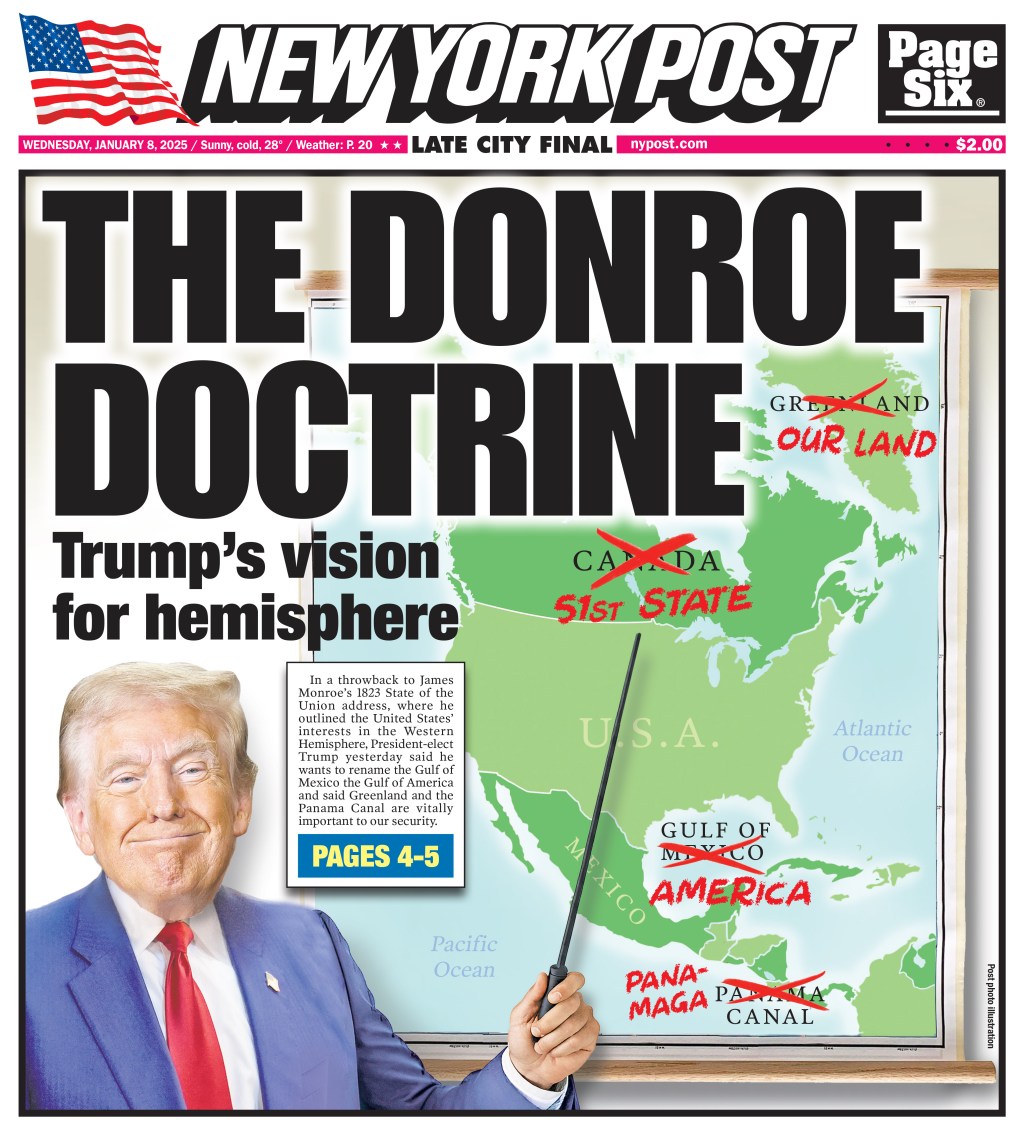
(Source: New York Post)
The present diplomatic stand-off between the US and Venezuela is about oil, and its availability at a steady price without undue fluctuations.
Other forces, however, have been at work. Due to US imposed sanctions, for example, huge stockpiles of oil are presently available, elsewhere, outside the reach of the US, their allies and recognised oil-traders. Fears, therefore, have arisen about sudden sales of the stockpiles with a dramatic effect upon markets and official oil prices. The US, therefore, has followed diplomatic positions based in age-old neo-colonialist policies from yesteryear.
In recent months the US has staged a bigger military presence in the Caribbean. The sensitive geo-strategic area is the gateway to the southern half of the Americas, and faces the equally sensitive although much smaller area of Central America. For decades US hegemony in the region has been under siege following the demise of the Monroe Doctrine which placed the US at the pedestal of control of the western hemisphere.
Having overplayed their hand during the previous Cold War with brutal repressive regional policies which included the propping up of puppet military regimes, other forces have moved into the arena. US-led hegemony in the wider region is in decline. Progressive governments have no longer relied upon oligarchies and the US to exploit whole populations; China, likewise, is now a major trading partner, along with Russia.
Venezuela has long been a dominant player in the wider region, its geographical size and huge oil deposits once provided the US with the means of wider control. For thirty years, however, Venezuela has pursued a significantly different diplomatic course. The election of Hugo Chavez in 1999, following his seizure of power with a military coup, and his subsequent fourteen-year term of office, saw the country develop strong links with China, Russia and Iran. It was accompanied by the Bolivarian Revolution which included nationalisation of the dominant heights of industry and progressive reforms which were directed toward the working class and campesinos. The traditional ruling oligarchies, strongly backed by the US, have remained in opposition.
Chavez died in 2013, and his successor, Nicolas Maduro, has pursued similar policies to date. Venezuela and the Bolivarian Revolution have, in many ways, become a pivotal point for the southern half of the Americas and their diplomatic relations with the US; they have symbolised the successful struggle against the US-led Monroe Doctrine which historically underpinned all diplomacy in the Americas, and the present-day changing balance of forces.
Events during the earliest days of the previous Cold War remain important considerations.
In April, 1948, the 9th International Conference of the American States held in Bogata, Colombia, endorsed a charter for the creation of the Organisation of American States (OAS). It coincided with a London meeting of western countries convened two months earlier to create a military bloc aimed primarily at the Soviet Union and their allies. The ensuing Cold War saw the US reach their peak of western domination in a continuation of the previous century’s Monroe Doctrine. It included the southern half of the Americas being labelled the 'backyard'; neo-colonialism, was considered by Washington, as the order of the day. Europe was an ally.
The US, however, has encountered a credible challenge to their traditional hegemonic positions with the emergence of China, the Russian Federation and trade blocs including BRICs. Washington and the Pentagon have been increasingly thrown back on defensive positions; the Russian invasion of Ukraine has been a typical example of their inability to control developments in what they previously regarded as their area of influence.
In August 2025, for example, high-level diplomatic meetings and negotiations between Trump and Putin with a US request for a ceasefire or comprehensive settlement were not supported by Russia. (1) It was to have far-reaching implications for what the US regarded as vital supply-lines used by Russia in what is quite clearly a military operation against Venezuela.
The US military build-up in the Caribbean was ostensibly directed toward Venezuela on spurious grounds that the Maduro government were exporting drugs to the US. No evidence was ever provided to substantiate the diplomatic standpoint. A series of US missile strikes subsequently targeted what were regarded as fishing boats and at least 83 seafarers are reported killed since 2 September.
The prevailing diplomatic position has remained very tense, with France and the UK suspending the sharing of some intelligence with their US counterparts in opposition to the targeted strikes. Both European countries, as former colonial powers in the Caribbean, still possess extensive signals-intelligence (SIGINT) and other surveillance facilities in the region. (2)
Behind the scenes, however, the US possesses a far murkier motive.
Due to the Trump administration imposing tariffs upon Venezuela and many of its allies, a huge glut of oil has been created; fifteen per cent of global totals remain subject to official US sanctions. (3) It threatens US control of the global oil industry. It has been estimated, for example, that there are 1.4 billion barrels of oil in vessels based at sea in transportation elsewhere, an increase of 24 per cent over totals for the previous 2016-2024 period. (4)
While there has been a sixteen per cent increase in barrels from mainstream producers, supply is also increasing from countries outside of OPEC. (5)
A similar surge in oil production from countries including Venezuela, Russia and Iran, likewise, has raised concerns about 'dark barrels', which have surged 82 per cent in the past three months. (6) The same timespan, interestingly, coincides with the Trump administration beginning their military build-up in the Caribbean and the fake war on drugs.
Disclosures emerging from the European Union about their own sanctions upon Russian energy exports, moreover, contain numerous references to how Moscow has created a parallel system of transportation, trade and payments 'that insulates them from western sanctions … for … Russia's so-called shadow fleet'. (7) The fact that Russian oil already trades at a discount to other US-backed oil producing countries not affected by sanctions, has thrown doubt upon whether the Trump administration even controls the problem. (8)
The fact that Russia's war with the Ukraine is largely financed by its oil sales has added further weight to the question of whether Washington's diplomatic hostilities with Venezuela remain based in initiatives by the Trump administration attempts to broker an end to the Russia-Ukraine crisis. It would appear highly likely, when considering the time-span which coincides with US-Ukraine diplomatic meetings.
China is also a player, behind the scenes: throughout the period China has been stockpiling oil which it regards as a strategic reserve; it has added about 290,000 barrels of oil a day into storage during 2025. (9) It has been noted from official sources that China, to date, has amassed a stockpile of about 97 million barrels of oil, in various facilities around the world.
It has also been noted that sanctions imposed by the Trump administration have made all medium to longer-term projections questionable and unreliable. The White House ball-game keeps changing, as do the likely scenarios into what is regarded as uncharted territory.
The nightmare scenario for the US and their allies, however, is that if China starts to make its oil stockpiles globally available, it 'could cause the floor to fall out from under the price'. (10) Fluctuations in oil prices would take place, with serious implications for everyday usage in western countries and vital industries.
The fears of such a scenario taking place was a motive for the US to seize the huge oil tanker, the Skipper. It was carrying an estimated 1.1 million barrels of crude oil. (11) Questions still remain about the actual owner of the vessel and whether its cargo was insured, with legal implications which have yet to be openly verified. The seizure of the oil tanker was followed by the Trump administration ordering a 'total and complete blockade of all sanctioned oil tankers entering and leaving Venezuela', in mid-December. (12) The US has also threatened to seize more oil tankers. (13) The decision, likewise, by the European Union to sanction two oil traders it has accused of facilitating Russian involvement and participation in a 'clandestine market' has also followed as if in logical sequence to US diplomatic initiatives. (14)
There remains little ambiguity in the position of the US toward Venezuela; it clearly marks a diplomatic attempt to reassert the Monroe Doctrine with subsequent implications for the southern half of the Americas and the changed balance of forces. A recent statement issued by the White House, for example, included reference to the Maduro government returning 'oil, land, and other assets that they have previously stole from us'. (15) In the name of the Bolivarian Revolution, Venezuela seized US oil projects operated by Exxon and ConocoPhilips after the companies rejected contracts by the Chavez administration which gave Venezuela control of its own oil. The position is now being challenged by the Trump administration; sovereignty is not a problem for Washington. It does not exist for Venezuela.
The US moves, therefore, can be seen to mark an attempt to re-introduce neo-colonial type policies toward Venezuela, in line with similar policies toward the southern half of the Americas and elsewhere.
They should be resisted: Australia should have an independent foreign policy!
1. Russia's war against Ukraine, Congressional Research Service, (Washington), 5 September 2025.
2. The flashpoints leading the US and Venezuela, ABC News, 28 November 2025.
3. A billion-barrel oil glut forming at sea, Australian, 12 December 2025.
4. Ibid.
5. Ibid.
6. Ibid.
7. EU sanctions hit Russian oil trade tsars, Australian, 17 December 2025.
8. Ibid.
9. Australian, op.cit., 12 December 2025.
10. Ibid.
11. Trump ups the ante in Caracus, Editorial, Australian, 12 December 2025.
12. US hits Maduro with oil blockade, Australian, 18 December 2025.
13. Ibid.
14. Australian, op.cit., 17 December 2025.
15. Australian, op.cit., 18 December 2025.
Print Version - new window Email article
-----
Go back
Independence from Imperialism
People's Rights & Liberties
Community and Environment
Marxism Today
International
Articles
| US-ROK Freedom Shield and other tensions |
| The forked tongue of US policy on the Asia Pacific |
| The Trump Administration and the scramble for the Pacific sea-bed |
| US developing kinetic and non-kinetic weapons for space war |
| The U.S. government, the Pentagon and big tech: key components of U.S. imperialism. Part 1 |
| Zionist war machine never so isolated |
| New booklet on China’s Imperialist Expansion |
| Country Report of the Socialist Party of Bangladesh to the ICOR Asia Conference, Kathmandu, Nepal 04.07.2026 |
| Asian Continental Report for ICOR Asian Conference |
| ICOR Asian Continental Conference - Report from Australia |
| “We must ensure the next war is won, not lost, in space” says retired US Air Force general |
| Report from Sri Lanka |
| 'Dispersed operations': Pentagon upgrades the Indo-Pacific Strategy |
| ICOR declaration: Forward with the popular uprising in Bolivia, an end to oppression! |
| Contradictions and conflicts in the race for Space |
| Can the US withstand the BRICS challenge? |
| Fight the Militarisation of Space |
| ICOR Statement on Nakba Day, May 15, 2026 |
| The US War Budget and the Pacific (Pt. 1) |
| ICOR declaration: Resolute Solidarity with the Cuban People Against the Sanctions and Threats of U.S. Imperialism |
-----