
A Tale of Two Imperialisms – Part 2
Written by: Nick G. on 26 April 2026
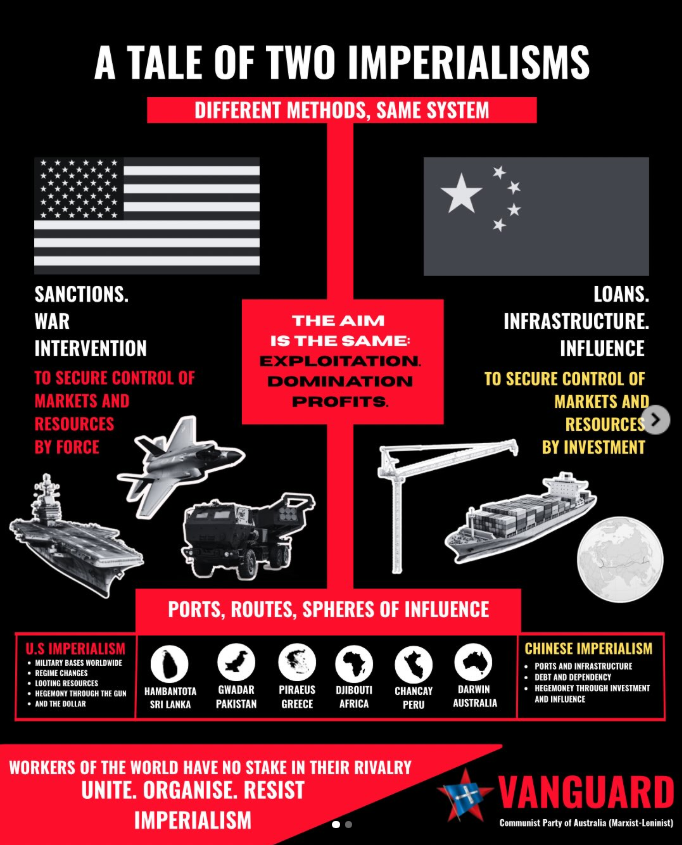
In our previous article on this topic, we compared the different strategies of US imperialism and Chinese social-imperialism, one in decline and one on the rise, and in particular looked at Chinese investment in Peru’s port of Chancay. In Part 2, we will look at Chinese investments in other ports, including Darwin’s.
Hambantota
The Sri Lankan port of Hambantota is perhaps the most well-known example of China’s port acquisitions. The port was built with Chinese loans, and when the Sri Lankan government could not repay these, the Chinese took control of the port under a 99-year lease.
Hambantota is strategically located within the Indian Ocean region and is under Chinese operational control. The deal which led to this was widely touted by the rival US-led imperialist bloc as an example of Chinese debt-diplomacy, as a case where financial distress led to loss of control over infrastructure. However, Hambantota is unique in that respect; China’s other major port acquisitions have had more of a straight commercial character.
Gwadar Port
Also strategically located, the Pakistani port of Gwadar is in the Arabian Sea region of the northern Indian Ocean, and was built to facilitate China’s global logistics strategy and as part of a broader economic corridor between the two countries. It is designed to feed into the China–Pakistan Economic Corridor, a 3000 km land route between the two countries. It provides China with a shorter route for oil imports from the Middle East, bypassing the Straits of Malacca. The port has a heavy geo-political significance but has not lived up to commercial expectations. Like Chancay, Gwadar was built with Chinese capital investment and is under Chinese operational control.
Adjacent to the port is a Special Economic Zone. The land was handed to the China Overseas Port Holding Company in November 2015 as part of a 43-year lease. The site will include manufacturing zones, logistics hubs, warehouses, and display centres. Businesses located in the zone will be exempt from customs authorities as well as many provincial and federal taxes. Businesses established in the special economic zone will be exempt from Pakistani income, sales, and federal excise taxes for 23 years. Contractors and subcontractors associated with China Overseas Port Holding Company will be exempt from such taxes for 20 years.
Last December, the Indian online magazine Maritime Gateway criticised plans to establish a multinational maritime fusion centre linked to Gwadar. Such centres gather and analyse data on shipping movements, naval deployments, commercial traffic and behavioural patterns at sea. The Indian analysts, similar to their US counterparts who worried about China’s navy being able to use Peru’s Chancay Port, believe that with Chinese personnel, software and analytical systems embedded on Pakistani soil, control over data becomes ambiguous, making Gwadar less a national commercial port and more a strategic platform for China. Whatever the truth of the Indian claims, it is certainly the case that the commercial and the military components of port acquisitions are closely linked.
Djibouti
Djibouti sits at the entrance to the Bab el-Mandeb Strait, linking the Indian Ocean to the Red Sea and the Suez Canal—one of the busiest shipping routes on Earth. Around 12–20% of global trade passes through this chokepoint.
China has both a commercial port (Doraleh) and a naval base in Djibouti – its first overseas military base. The latter was built in 2017, and justified as resupplying and maintaining Chinese naval ships operating in the Indian Ocean and conducting anti-piracy patrols in the Gulf of Aden.
The Djibouti naval base marked a change in the Chinese Navy’s role. Formerly, when China was socialist, it was for China’s coastal defence. But by 2015 and the publication of that year’s White Paper on China’s military strategy, its tasks now had to include:
-- To safeguard China's security and interests in new domains;
-- To safeguard the security of China's overseas interests;
To carry out its mission and strategic tasks, the White Paper identified a change from a focus on land-based defence to a focus on blue-water protection of
overseas interests:
“The traditional mentality that land outweighs sea must be abandoned, and great importance has to be attached to managing the seas and oceans and protecting maritime rights and interests. It is necessary for China to develop a modern maritime military force structure commensurate with its national security and development interests, safeguard its national sovereignty and maritime rights and interests, protect the security of strategic SLOCs and overseas interests, and participate in international maritime cooperation, so as to provide strategic support for building itself into a maritime power.”
The change to a blue water Navy capable of operating globally will require more than just one base for resupply, maintenance and shelter.
Port of Piraeus
This Greek port is majority-owned by COSCO, which has turned it into one of the busiest ports in Europe. It is also home to one of the most militant sections of the Greek working class who have been at the forefront of refusing to service NATO ships and vessels bound for Israel.
Both major Greek Communist Parties opposed the sale of Piraeus to COSCO. This is significant as the larger revisionist Greek Communist Party (KKE) was a founder of the pro-Chinese International Meeting of Communist and Workers’ Parties in 1998. The Communist Party of China is a member.
The KKE opposed COSCO’s purchase of Piraeus in a privatisation fire-sale demanded by the IMF. The KKE has come to reject the idea that China remains socialist. It argues that Chinese overseas investments, including Piraeus, are driven by monopoly capital and geopolitical competition. KKE-affiliated unions have protested working conditions under COSCO management, highlighting precarious contracts, safety concerns, and anti-union practices. In 2021, thousands protested the death of a fellow worker, carrying a large banner reading “No more dead workers for the profits of COSCO”.
The Communist Party of Greece (Marxist-Leninist) also opposed COSCO’s takeover of Piraeus. On 27 May, 2017 it published “The Silk Road and the struggles for the looting of the country's wealth”, saying:
“In our country, Cosco's investment in Piraeus is already a fact and is of enormous and strategic importance since the common goal of the Greek bourgeoisie and the Chinese bourgeoisie, as Tsipras said in Beijing and agreed by Xi Jinping, is for Piraeus to become the largest commercial center in the Mediterranean. At the same time, China's gateway to Europe, with all that this implies for a number of other investments that are attracted. The recent validation of the purchase of 24% of IPTO by the Chinese State Grid is also a fact. Also during Tsipras' visit to Beijing, a 500 million agreement was signed between Forthnet and ZTE in fiber optics, while the Copelouzos group signed a memorandum of understanding for investments in energy with the state-owned company Shenhua Group estimated at 3 billion.”
Darwin
In 2015, the Northern Territory government signed a 99-year lease for the operation of the Port of Darwin with the Chinese company Landbridge, a large private company based in Rizhao city in Shandong Province in China.
Although Darwin’s port is not on the scale of the others mentioned in this article, it is Australia’s nearest port to Asia and the nation’s ‘northern gateway’ for Australasian trade including livestock. It is also a key support hub for the expanding offshore oil and gas fields in the Arafura Sea, Timor Sea and waters off the coast of Western Australia.
The lease was immediately controversial because of the port’s proximity to the US Marine Rotational Force–Darwin (MRF-D), announced by the Gillard Labor government in 2011. It began as a rotational deployment of 200 marines, expanded to 1500 in 2014, the year before the lease arrangement for the port was signed.
Although Landbridge is a commercial operator and there is no Chinese military presence at Darwin, the port’s proximity to a continuously expanding US imperialist military presence highlights the rivalry of these two powers, not just in our region, but on our country.
Since the leasing arrangement, the MRF-D has grown to 2500 US marines, and despite still being referred to as a rotational deployment, it is effectively continuous: a new rotation arrives each year.
U.S. forces now operate from or access:
• Robertson Barracks (Darwin)
• RAAF Base Darwin
• RAAF Base Tindal (near Katherine)
Australia and the U.S. have expanded northern air bases to support U.S. aircraft, including long-range bombers that can carry nuclear weapons. There has also been development of facilities for fuel storage, equipment storage and location, and maintenance. These enable rapid U.S. force projection into Southeast Asia. In addition, the NT regularly hosts foreign armed forces in so-called training exercises.
So, should the port of Darwin continue to be operated by the Chinese?
We say no, at the same time as we say that there must be no US bases in Australia.
In fact, most ports in Australia are operated by foreign capital and foreign investors. This is untenable. All Australian ports should be owned and operated by a national ports authority.
And the expansion of the US military presence in Australia must be ended.
Our position is that US imperialism is currently the more dangerous of the two imperialisms and the major source of the danger of a war with China.
Print Version - new window Email article
-----
Go back
Class Struggle and Socialism
Independence from Imperialism
People's Rights & Liberties
Community and Environment
Marxism Today
International
Independence from Imperialism
People's Rights & Liberties
Community and Environment
Marxism Today
International
Articles
| Condemn the US placement of weapons in Outer Space |
| Pax Silica, the Philippines and US war preparations against China |
| New Zealand is being drawn into US plans to achieve military supremacy in space. |
| US-ROK Freedom Shield and other tensions |
| The forked tongue of US policy on the Asia Pacific |
| The Trump Administration and the scramble for the Pacific sea-bed |
| US developing kinetic and non-kinetic weapons for space war |
| The U.S. government, the Pentagon and big tech: key components of U.S. imperialism. Part 1 |
| Zionist war machine never so isolated |
| New booklet on China’s Imperialist Expansion |
| Country Report of the Socialist Party of Bangladesh to the ICOR Asia Conference, Kathmandu, Nepal 04.07.2026 |
| Asian Continental Report for ICOR Asian Conference |
| ICOR Asian Continental Conference - Report from Australia |
| “We must ensure the next war is won, not lost, in space” says retired US Air Force general |
| Report from Sri Lanka |
| 'Dispersed operations': Pentagon upgrades the Indo-Pacific Strategy |
| ICOR declaration: Forward with the popular uprising in Bolivia, an end to oppression! |
| Contradictions and conflicts in the race for Space |
| Can the US withstand the BRICS challenge? |
| Fight the Militarisation of Space |
-----