
Contradictions and conflicts in the race for Space
Written by: Nick G. on 27 May 2026
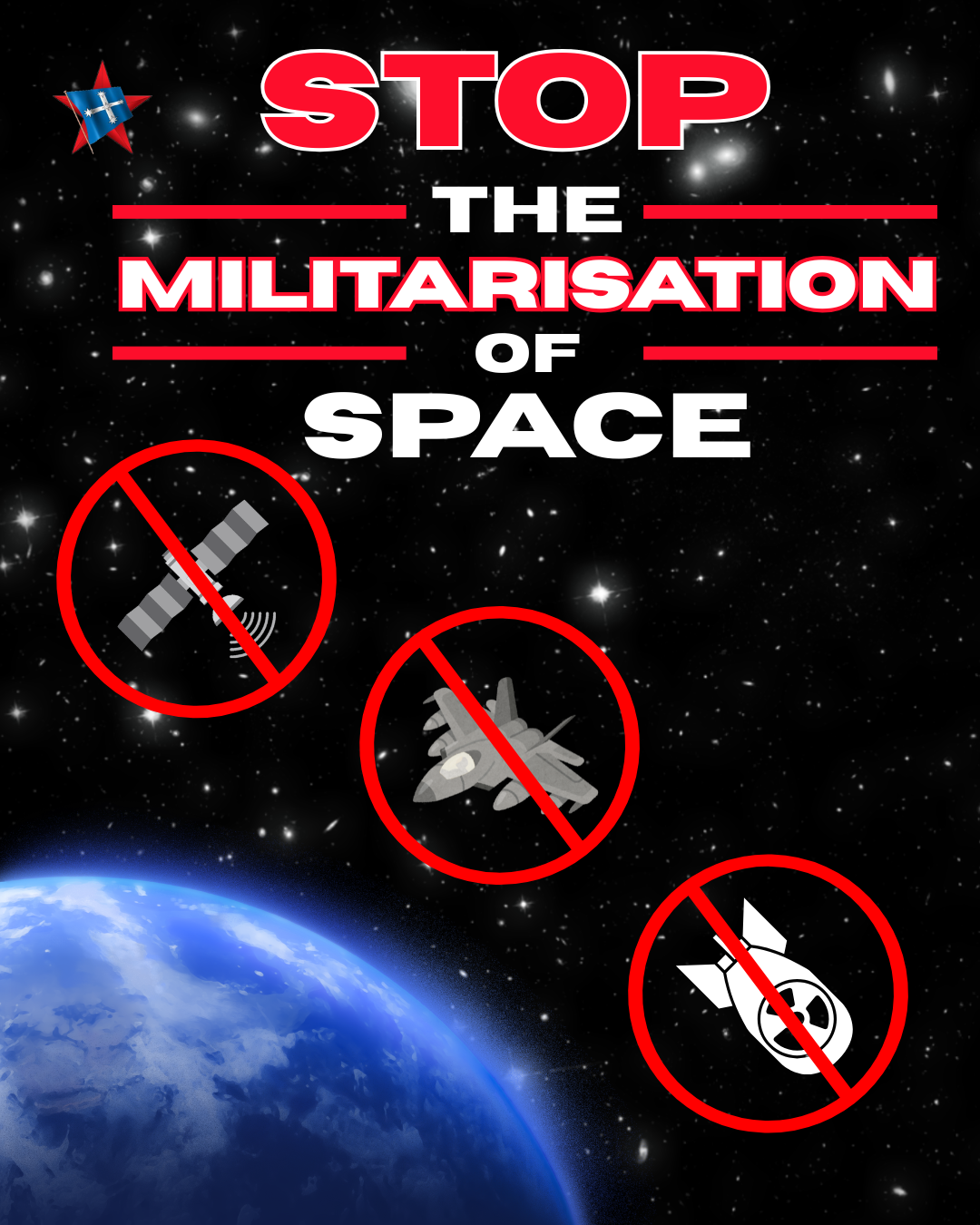
The contest for the domination of Space between China and the US is reflected in yesterday’s (May 26) announcement by NASA that it plans to inhabit the Moon. However, the hawks pushing for a militarised Space are demanding to be included in the action.
Since Trump’s appointment of Jared Isaacman as NASA Administrator last December, NASA has released various announcements about US objectives, particularly in relation to the Artemis II circumnavigation of the Moon. Isaacman in his private capacity has flown in Space aboard Elon Musk’s SpaceX Inspiration4. He is a billionaire whose wealth came from a credit card processing company he founded, and he has a private fleet of jet fighters to train the U.S. military for aerial combat.
Yesterday’s announcement packaged previous statements into a plan for a permanent lunar outpost, involving robotic landers, moon buggies and hopping drones before the expiry of Trump’s presidency. Placing astronauts on the Moon by this date will also give the US a jump on China, which currently has four astronauts (Taikonauts) on permanent rotation aboard its Tiangong space station. It has announced plans to land two astronauts on the Moon before 2030.
The threat of lunar colonisation
The 1967 UN Outer Space Treaty (OST) defines the Moon and all outer space as the "province of all mankind". It says that outer space is “not subject to national appropriation by claim of sovereignty, by means of use or occupation, or by any other means”.
Despite this, the US is commercialising its work in Space and speaks of the Moon as its property.
On 24 March, Isaacman said that “NASA is committed to achieving the near impossible once again, to return to the Moon before the end of President Trump’s term, build a Moon base, establish an enduring presence, and do the other things needed to ensure American leadership in space… This time, the goal is not flags and footprints. This time, the goal is to stay. America will never again give up the moon.”
The White House’s official X account released a graphic with Isaacman’s pledge.

Military muscling in
Belligerent and hawkish opinion makers in the military are demanding their cut of the action.
They point out that China’s space program is “completely military-led” whereas “the United State has long maintained separation between its military and civilian space enterprises.”
This, claims Col. Kyle Pumroy (Ret.) writing in the Mitchell Institute for Aerospace Studies’ paper “Military Human Spaceflight: A Key Component to US Space Superiority”, places the US at a disadvantage in the race with China for control of Space.
Sounding like something out of science fiction, Pumroy argues that “now is the time to begin placing Guardians in space to develop the skills, tools, and concepts to build a future capacity to defend core US interests…”
“Guardians”? The term was adopted by the US Space Force in 2020 for its service members, analogous to “soldiers” in the Army or “sailors” in the Navy. So “Guardians in Space” means actual Space Force personnel physically operating in orbit, on space stations, or potentially on the Moon, rather than controlling satellites remotely from Earth.
As a branch of the military, Pumroy argues, the Guardians need the legal protection of the US Congress’ Title 10 of the US Code which authorises all aspects of military organisation and operation.
“While upholding the OST should be the United States’ desire and priority, pragmatically, it must prepare otherwise,” writes Pumroy. “Only Guardians can ensure human spaceflight dominance and maintain the strategic flexibility to conduct Title 10 operations in defence of US interests in space.”
In the Communist Manifesto, Marx and Engels made the observation that “The need of a constantly expanding market for its products chases the bourgeoisie over the entire surface of the globe. It must nestle everywhere, settle everywhere, establish connexions everywhere.”
Now, with Isaacman, the logic of colonial exploitation reemerges with this commercial imperative: “The Artemis program will live on past any one launch vehicle, and at some point in the future, transition to commercial pathways with crewed missions as often as every six months to ensure we never give up the Moon again…. stimulates a lunar economy…(and) Ignite the orbital economy – launch frequent astronaut missions to the Space Station, prioritize high ‘commercial potential’ science, work to stimulate more private astronaut missions and support a transition to one or more commercial space stations.”
Stop the militarisation of Space!
No to the colonisation of the Moon!
End the US-China Space race!
Print Version - new window Email article
-----
Go back
Independence from Imperialism
People's Rights & Liberties
Community and Environment
Marxism Today
International
Articles
| The US war with Iran – Trump’s military debacle |
| Palestine, Fascism and the Bankruptcy of Parliamentary Socialism |
| Revisionists say China cannot be imperialist |
| Press Statement by Nepal Communist Party (Mashal) |
| Party’s discussion paper published |
| 2026 Pacific Islands Forum: safe, not sorry? |
| “Imperialism wounds so many people. We can’t look away.” |
| Condemn the US placement of weapons in Outer Space |
| Pax Silica, the Philippines and US war preparations against China |
| New Zealand is being drawn into US plans to achieve military supremacy in space. |
| US-ROK Freedom Shield and other tensions |
| The forked tongue of US policy on the Asia Pacific |
| The Trump Administration and the scramble for the Pacific sea-bed |
| US developing kinetic and non-kinetic weapons for space war |
| The U.S. government, the Pentagon and big tech: key components of U.S. imperialism. Part 1 |
| Zionist war machine never so isolated |
| New booklet on China’s Imperialist Expansion |
| Country Report of the Socialist Party of Bangladesh to the ICOR Asia Conference, Kathmandu, Nepal 04.07.2026 |
| Asian Continental Report for ICOR Asian Conference |
| ICOR Asian Continental Conference - Report from Australia |
-----