
US pushes QUAD to counter China’s southern diplomacy
Written by: (Contributed) on 3 November 2026
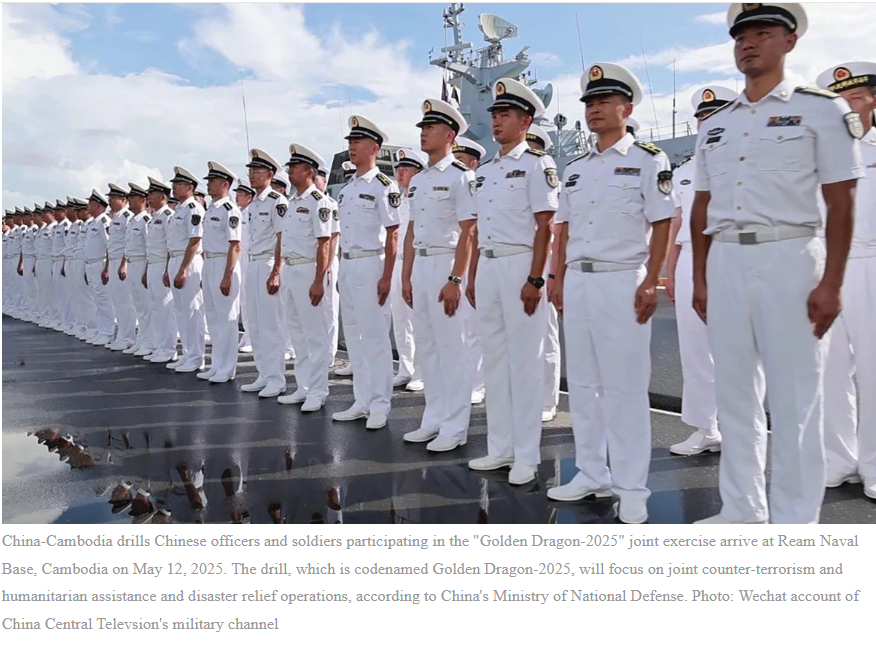
The surprise meeting scheduled for QUAD representatives on the sidelines of the forthcoming ASEAN and East Asia summits in mid-November would tend to indicate reassessments of the regional balance of forces have raised concerns. A formal agenda for the high-level diplomatic meeting is set to be finalised in late October. It is not coincidental that the meetings will take place in Manila; the Philippines retains a central position for US regional diplomacy, 'US interests' and a series of nine sensitive military facilities, largely in the north of the country, facing various areas of tension.
An announcement that QUAD leaders would be meeting in Manila during mid-November was met with surprise; the US-led regional defence and security body had lain virtually dormant for the last three years. (1) The QUAD was established in order to present a challenge to China in the Indo-Pacific region. It was rested upon a Pentagon updated Indo-Pacific Strategy (IPS) in which the Philippines had a central geo-political and strategic position. (2) It also included the upgrading of the US-Japan alliance into the status of a global alliance. (3)
Calls for Australia to strengthen its diplomatic links with Japan are, therefore, best assessed in that light: in what has been described by Canberra as 'the deteriorating regional and global environment, raising concerns over the reliability of the historic US security guarantee'. (4) Australia has, historically, been a southern hub for US regional interests; Japan has been its northern counterpart. The US has thrust greater responsibilities on both.
The announcement also coincided with a report from the International Monetary Fund (IMF), that global economic growth is slowing; while it reached 3.5 per cent last year, it is now set to drop to 3.1 per cent. (5) The report also warned that if the US-Iran war continued for longer that 'global growth will be significantly lower and inflation much hotter'. (6) With the Middle East entering into a period of prolonged turmoil, the war has shown no sign of ending in the foreseeable future. Fuel prices have already escalated; and will do so still further.
Despite the US-led global economic uncertainty, however, countries associated with the regional ASEAN have developed stronger links with China, raising further diplomatic concerns over related factors and considerations. China, for example, has been ASEAN's leading trading partner since 2009, and ASEAN's largest since 2019. (7)
In recent times it had strengthened trade links still further: last year ASEAN recorded China's trade had increased by 7.4 per cent over the previous year; in the period January-July 2026, total trade had reached US$744 bn, an increase of 24.7 per cent over the same period for 2025. (8) The forthcoming QUAD diplomatic meeting, therefore, is best assessed in that light, with other related factors and considerations.
It is particularly important to assess the significance of China's diplomatic relations with specific ASEAN countries and how trade considerations have merged with other factors.
Cambodia has provided a good vantage point to highlight the predicament confronting the QUAD, and the rapidly changing balance of forces.
Cambodia, historically, part of French-controlled Indo-China, has had a troubled and traumatic and poverty-stricken history. After joining ASEAN in 1999, however, China responded with financing 132 joint projects in the following fifteen years. (9) They formed the basis of longer-term diplomatic co-operation. In April this year, for example, an official diplomatic note announced the two countries would 'deepen strategic relations'. (10)
The diplomatic initiatives also included China fostering closer relations with neighbouring Vietnam, also a former part of Indo-China, with troubled relations with Cambodia. Vietnam, furthermore, previously opted to join the US’s Indo-Pacific Strategy alongside the ROK, Singapore, Taiwan and others. (11) Vietnam's diplomatic relations with the US now appear to have become problematic and far from straightforward.
While China's deepening diplomatic links with the region have included the Ream joint naval facility in Cambodia and the Ban Keun joint air force base in Laos, Beijing's relations with Vietnam have correspondingly challenged their role inside the IPS. (12) Washington and the Pentagon appear to have failed in recruiting Vietnam into the IPS as a potential stalking horse to serve 'US interests'.
A statement from Canberra about China's diplomacy toward Laos and the Ban Keun base noted it was a 'clear win for China … and a security concern for the US'. (13)
Meanwhile an official media release from the Philippine government noted the close relations between China and Cambodia 'fuel suspicions' for the US. (14) The Pentagon, moreover, has assessed the Ream Naval Base as 'a strategic military outpost'. (15)
The Ream Naval Base has been perceived by policymakers in Washington, DC, primarily as a threat to regional security within the broader strategic rivalry outlined in the 2018 US National Defense Strategy, which accuses China of leveraging military modernization to reshape the Indo-Pacific region to its advantage.
It is also not coincidental that the diplomatic statements were issued from Manila; the nine military facilities under US control are clearly used for regional intelligence-gathering. While their main focus, previously, were the more problematic areas of the region, including the Taiwan Straits and Korean Peninsula, recent developments in Cambodia and Vietnam appear to indicate a clearly visible changing regional balance of forces away from traditional hegemonic positions enjoyed by Washington and the Pentagon.
1. Quad leaders find a Manila envelope, Australian, 22 October 2026.
2. The reasons behind Washington's push for GSOMIA., (Diagram), Hankyoreh, 12 November 2019.
3. Ibid.
4. 'Grand bargain': The case for a Japan treaty, Australian, 15 October 2026; and, Study: US no longer dominant power in the Pacific, Information Clearing House, 22 August 2029.
5. Global growth stalling, warns IMF., Australian, 14 October 2026.
6. Ibid.
7. Official websites: ASEAN; and, Towards and Equal Partnership, East Asia Forum, Vol. 15, No. 3, September 2023, pp. 3-5; and, Japan as a diplomatic asset to ASEAN, ibid., pp. 6-8.
8. ASEAN, ibid.
9. Wikipedia: Cambodia-China Relations.
10. Cambodia, China upgrade 2+2 dialogue to 3+3, The Asia News Network, 24 April 2026.
11. Hankyoreh, op.cit., 12 November 2019.
12. China's first foreign military air base, Australian, 15 October 2026; and, Vietnam and China get closer, The Guardian, 4 May 2026.
13. Australian, ibid., 15 October 2026.
14. China's foreign, defence ministers, The Manila Bulletin, 23 April 2026.
15. Ibid.
Print Version - new window Email article
-----
Go back
Independence from Imperialism
People's Rights & Liberties
Community and Environment
Marxism Today
International
Articles
| US pushes QUAD to counter China’s southern diplomacy |
| Declaration by ICOR (Europe) Transnational Days of Action and Strikes: The youth rebellion is justified! Forward to the workers’ offensive! |
| The US war with Iran – Trump’s military debacle |
| Palestine, Fascism and the Bankruptcy of Parliamentary Socialism |
| Revisionists say China cannot be imperialist |
| Press Statement by Nepal Communist Party (Mashal) |
| Party’s discussion paper published |
| 2026 Pacific Islands Forum: safe, not sorry? |
| “Imperialism wounds so many people. We can’t look away.” |
| Condemn the US placement of weapons in Outer Space |
| Pax Silica, the Philippines and US war preparations against China |
| New Zealand is being drawn into US plans to achieve military supremacy in space. |
| US-ROK Freedom Shield and other tensions |
| The forked tongue of US policy on the Asia Pacific |
| The Trump Administration and the scramble for the Pacific sea-bed |
| US developing kinetic and non-kinetic weapons for space war |
| The U.S. government, the Pentagon and big tech: key components of U.S. imperialism. Part 1 |
| Zionist war machine never so isolated |
| New booklet on China’s Imperialist Expansion |
| Country Report of the Socialist Party of Bangladesh to the ICOR Asia Conference, Kathmandu, Nepal 04.07.2026 |
-----