
BOOK REVIEW—The Eye of the Master: A Social History of Artificial Intelligence
Written by: Alex M and Duncan B on 6 February 2026
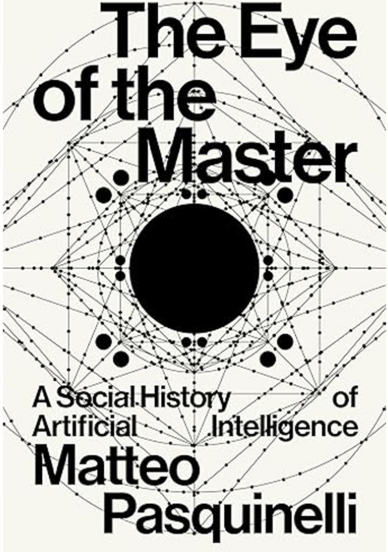
Matteo Pasquinelli, the author of The Eye of the Master- A Social History of Artificial Intelligence, is Associate Professor in Philosophy of Science at the Department of Philosophy and Cultural Heritage of Ca’ Foscari University Venice. His research focusses on the intersection of Philosophy of mind and language, political economy and the techniques of automation such as AI.
The Eye of the Master is an important book because it looks at AI from a Marxist viewpoint. Pasquinelli begins by tracing the origins of AI in the division of labour in the 19th century factories. He examines Babbage’s Difference Engine which was an early invention in computing. Its principle was based on a division of labour.
Pasquinelli examines the invention of machinery and in doing this he refers extensively to Volume 1 of Marx’s Capital, and to his earlier book Grundrisse: Foundations of the Critique of Political Economy.
In Volume 1 of Capital Marx wrote, “The machine, which is the starting point of the industrial revolution, replaces the worker, who handles a single tool, by a mechanism operating with a number of similar tools and set in motion by a single motive power, whatever the form of that power.” The need for a constant source of power which could be easily regulated led to the invention of the steam engine.
The spread of capitalism world-wide and the increasing size and complexity of factories created the need for more advanced systems of control and communication. This need gave rise to developments such as cybernetics, operations research, computers and the early forerunners of today’s AI such as pattern recognition machines.
Amid all the hype surrounding AI and the millions of words being written about it, it is easy to forget that AI is just another new application of technology, in this case computer technology.
Workers have been confronting new technology for over 250 years, since the late 18th century when spinning and weaving became mechanised. The development of steam power allowed machinery and the workers who operated it to be concentrated in factories.
In chapter 15 of Capital Vol 1, titled Machinery and Modern Industry, Marx showed how capitalists used machinery to the detriment of the workers. The use of machinery made it possible for commodities to be sold cheaper, reducing the need for workers to seek wage rises.
Machinery made it possible for 19th century capitalists to increase their profits by reducing the number of workers needed and by substituting the use of skilled workers with unskilled workers or women and children. The modern-day creators of AI are selling It based on the (as yet-unfulfilled) promise that it will allow capitalists to get rid of workers.
Machinery allowed capitalists to lengthen the working day to an intolerable extent. As Factories Acts came into force restricting the length of the working day, capitalists protected their profits by increasing the intensity of work in the shorter working day.
Capitalists used machinery to keep the workers under control and to repress strikes. In chapter 15 of Volume 1 of Capital, Marx wrote, “But machinery not only acts as a competitor who gets the better of the workman and is constantly on the point of making him superfluous. It is also a power inimical to him, and as such capital proclaims it from the rooftops and as such makes use of it. It is the most powerful weapon for repressing strikes, those periodical revolts of the working class against the autocracy of capital.”
Marx quotes from several inventors of machinery, factory owners and apologists for capitalism who boast how machinery has enabled the defeat of attempts at struggle by the workers.
One of those apologists was Andrew Ure, who was an early 19th century Scottish physician, chemist, geologist and viciously anti-worker business theorist. In his book The Philosophy of Manufactures, Ure spoke approvingly of how new machines used in calico printing and wool weaving enabled factory owners to defeat workers’ struggle and reassert their control over their workers.
Writing of the invention of the self-acting mule (an automatic machine to spin cotton and other fibres), he said: “With regard to the invention of the self-acting mule, a creation destined to restore order among the industrious classes. …This invention confirms the great doctrine already propounded, that when capital enlists science into her service, the refractory hand of labour will always be taught docility.” Today’s capitalists are in full agreement with Ure!
The modern-day tech billionaires behind AI are no different to the 19th century capitalists. In their pursuit of profits, they do not care about their own workers or anyone else harmed by their actions. They do not care about workers who will lose their jobs to AI. They also do not care about the effects of their activities on the environment.
The 19th century capitalists did not care about the pollution of the air, soil and water from their factories. The fact that data centres need enormous quantities of electricity and drinking-quality water does not worry the tech billionaires and would-be trillionaires.
***********
Duncan B above outlines the major strength of Pasquinelli’s book which is the historical contextualizing of AI. By situating AI as part of the ongoing technological advances that are part and parcel of capitalism Pasquinelli has made a significant contribution to our understanding of AI from a historical materialist perspective.
As Pasquinelli notes, Marx was aware that the introduction of machinery in manufacturing not only made workers more productive, it also had the effect of making workers mere appendages to the machines. Marx cited Adam Ferguson, the 18th century Scottish philosopher and mentor to Adam Smith where Ferguson highlighted the negative aspects of manufacturing industry: “Manufactures, accordingly, prosper most where the mind is least consulted, and where the workshop may … be considered as an engine, the parts of which are men.” Ferguson’s 18th century insights still resonate in this era of AI hype Pasquinelli asserts: “This should serve to remind us that the public mythology of artificial intelligence has always operated on the side of capital together with a hidden agenda to foster human stupidity, including the promulgation of racist and sexist ideologies.” (Pasquinelli, p. 111)
After forensically tracing the development of artificial intelligence in the twentieth century from its roots in Babbage’s Difference Engine in the early 19th century, Pasquinelli reaches some conclusions about AI: “Ultimately, AI is not only a tool for automating labour but also for imposing standards of mechanical intelligence that propagate, more or less invisibly, social hierarchies of knowledge and skill. As with any previous form of automation, AI does not simply replace workers but displaces and restructures them into a new social order.” (Pasquinelli, p.246)
Moreover, the growing demand for resources such as more computer chips, more electricity and water to power and cool massive date centres and the cloud infrastructure to host datasets etc, has contributed to the monopolization of data, knowledge and logistics.
Pasquinelli contends that we need to wrest our futures back from the big monopolies that are integral to the AI project:
To criticize and deconstruct complex artefacts such as AI monopolies, first we should engage in a meticulous work of deconnectionism, undoing – step by step, file by file, dataset by dataset, piece of metadata by piece of metadata, correlation by correlation, pattern by pattern – the social and economic fabric that constitutes them in origin. This work is already being advanced by a new generation of scholars who are dissecting the global production pipeline of AI … (Pasquinelli, p.252)
Evident here is the limit of Pasquinelli’s understanding of the urgent need of a more revolutionary approach to not only AI but the whole edifice of global capitalism and imperialism. Despite this shortcoming, Pasquinelli’s book is highly recommended for those who wish to understand the history and development of AI.
Print Version - new window Email article
-----
Go back
Independence from Imperialism
People's Rights & Liberties
Community and Environment
Marxism Today
International
Articles
| Firming up on fictitious capital – Firmus and its capital raising |
| Party’s discussion paper published |
| Notes on Barbarism – The Manifestation of Barbarism with the Decline of US Imperialism |
| Articles by Ted Hill now on our website |
| Financialisation: fictitious capital and its real impact |
| BOOK REVIEW-: The AI Con: How to Fight Big Tech’s Hype and Create the Future We Want |
| BOOK REVIEW—The Eye of the Master: A Social History of Artificial Intelligence |
| Three lies about value |
| US Department of War releases Strategy Document |
| Adventurist Class War Rejecting the Working Class |
| Productivity: of what? from whom? for whom? |
| More on Imperialism and Religion |
| Imperialists used religion to justify their actions |
| Building a New Socialist Society |
| The “three constantly read articles” should still be constantly read. |
| Two new publications to promote study and guide practice |
| Reply to a reader |
| Criticising Xi Jinping Thought |
| BOOK REVIEW---CULTURE IS NOT AN INDUSTRY |
| CPA (M-L) concludes 16th Congress |
-----